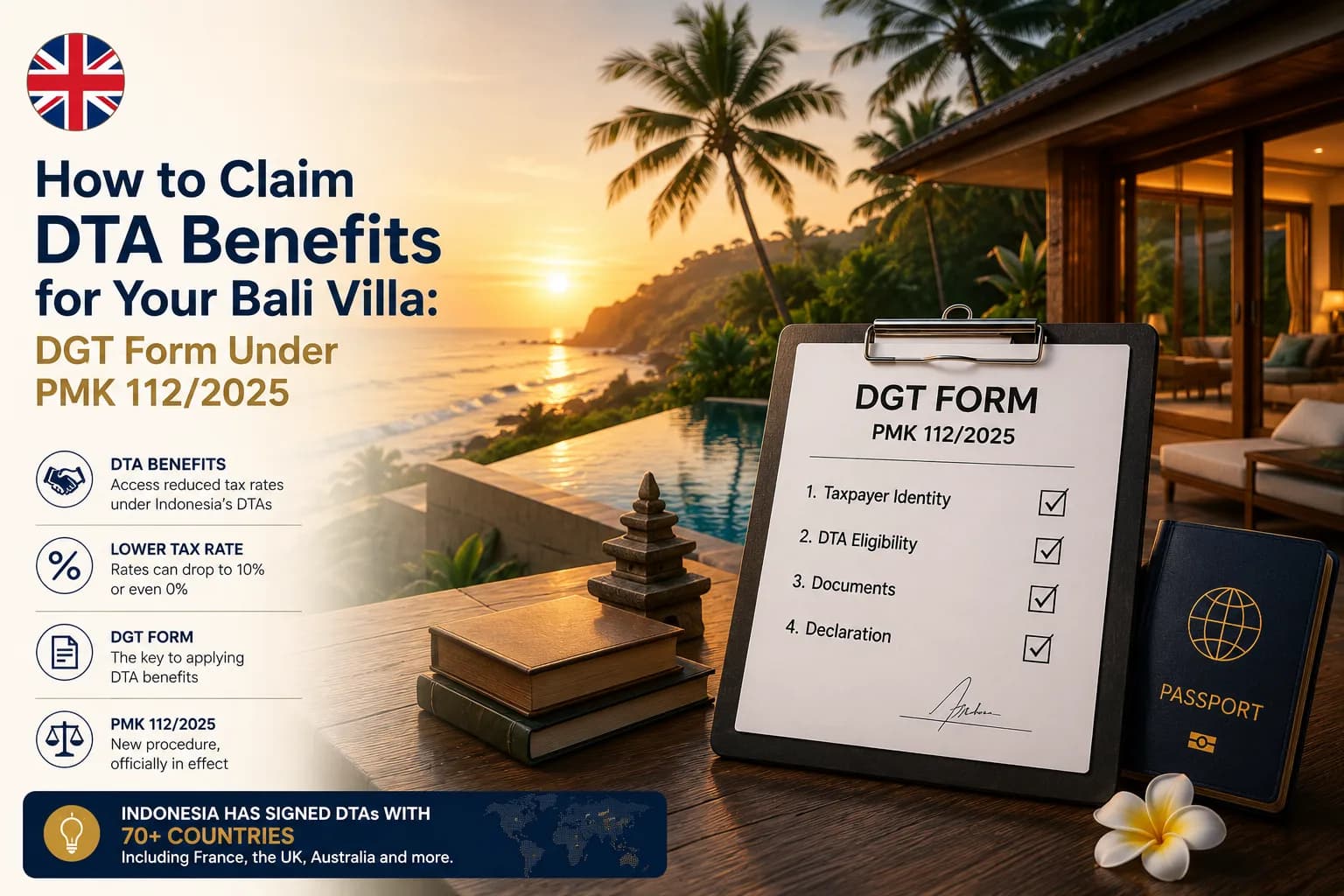
This guide explains how to claim DTA benefits for your Bali villa under the new PMK 112/2025 procedure (a frequently asked question among foreign property owners in Indonesia. If you own a villa in Bali and receive rental income, you are subject to PPh Pasal 26) the Indonesian withholding tax on income paid to foreign taxpayers (at the default rate of 20%. What many owners do not know is that Indonesia has signed Double Taxation Agreements (DTAs) with over 70 countries, including France, the United Kingdom, and Australia. Under these treaties, the applicable rate on certain income types can drop to 10% or even 0%. The mechanism to access these reduced rates is the DGT form. This guide explains every step of the process, which documents you need, and what traps to avoid) based solely on official sources from the Direktorat Jenderal Pajak (DJP) and verified legal references. Seo meta descriptions for this topic consistently show high search intent from expat villa owners across Southeast Asia.
What Is PPh Pasal 26 and How Does It Apply to Foreign Bali Villa Owners?
PPh Pasal 26 is the Indonesian withholding tax applied to gross income paid to non-resident taxpayers, individuals or entities that do not have a permanent establishment in Indonesia. For a French, British, or Australian citizen who owns a villa in Bali and rents it out through platforms such as Airbnb, Booking.com, Agoda, or Traveloka, the gross rental income paid or credited is subject to withholding at source.
The standard rate is 20% on the gross amount, per Article 26 paragraph (1) of the Indonesian Income Tax Law (UU PPh). There is no deduction for costs or expenses at this stage, the 20% applies to the total rental revenue before any expenses. This is a significant tax burden, particularly for villas generating Rp 300 million to Rp 600 million annually.
However, if Indonesia has concluded a DTA (Perjanjian Penghindaran Pajak Berganda, P3B) with your country of tax residence, a reduced withholding rate may apply to specific income categories. The three main categories relevant to villa owners are:
Article 6 (Immovable Property / Sewa Bangunan): Rental income from immovable property (which includes villa rentals) is typically taxable only in the country where the property is located. This means the DTA does not reduce the Indonesian rate on rental income. Indonesia has full taxing rights under virtually all its DTAs for income from real property situated in Indonesia. This is a critical point that many advisors misunderstand.
Article 10 (Dividends): If you hold your Bali villa through an Indonesian PT PMA (Penanaman Modal Asing) company and the company distributes dividends to the foreign shareholder, the DTA dividend rate applies, typically 10–15% instead of 20%.
Article 12 (Royalties) / Article 11 (Interest): Less commonly applicable to standard villa operations, but relevant if you license intellectual property to an Indonesian entity or have intercompany loans.
The practical implication: most individual foreign villa owners renting directly will not obtain a rate reduction on their rental income via a DTA, because Article 6 preserves Indonesian taxing rights. The DTA benefit is most relevant when income is structured as dividends from a PT PMA.
"Income from immovable property, including rental income, may be taxed in the Contracting State in which such property is situated.", Article 6, France–Indonesia DTA (Convention fiscale France-Indonésie, 1979, available atimpots.gouv.fr)
Sources: DJP official PPh 26 guide | PwC Indonesia Tax Book 2026
Understanding PMK 112/2025: The New Rules for Tax Treaty Application
PMK 112/2025 (Peraturan Menteri Keuangan Nomor 112 Tahun 2025) replaced the earlier PMK 25/2018 and introduced stricter and more transparent procedures for applying tax treaty benefits in Indonesia. The regulation was officially announced by the DJP and came into force in 2025. It applies to all withholding agents (pemotong pajak), including Indonesian companies, OTA local entities, or property managers acting as withholding agents on behalf of foreign villa owners.
The key changes introduced by PMK 112/2025 are:
Mandatory Certificate of Residence (CoR), No More Blanket Exemptions
Under the new rules, treaty benefits cannot be applied without a valid Certificate of Residence (Surat Keterangan Domisili, SKD) issued by the tax authority of the claimant's home country. For a French resident, this is an attestation de résidence fiscale from the Direction Générale des Finances Publiques. For a UK resident, it is a certificate of residence from HMRC. For an Australian resident, it is issued by the Australian Taxation Office (ATO).
The CoR must:
Be issued in the year in which the income is paid, or cover the relevant year
Confirm that the recipient is a tax resident of the treaty country
Be in the official language of the issuing authority (translation into Indonesian is recommended but not always mandatory)
Anti-Abuse Testing: Principal Purpose Test (PPT)
PMK 112/2025 formally introduces the Principal Purpose Test (PPT) as required by the OECD Multilateral Instrument (MLI) to which Indonesia is a signatory. Under the PPT, treaty benefits can be denied if one of the principal purposes of the arrangement was to obtain those benefits. This targets shell company structures in low-tax jurisdictions (Singapore, Netherlands, etc.) that interpose between the villa owner and the income. A genuine French resident receiving dividends from a legitimate PT PMA will generally pass the PPT. A British Virgin Islands holding company with no substance will not.
Mandatory e-Bupot Filing by the Withholding Agent
The withholding agent must file the Bukti Potong (withholding slip) for PPh 26 electronically via the DJP's Coretax system. The form is BP 26 (Bukti Potong PPh Pasal 26). For treaty claimants, the DGT form must be attached to the withholding documentation.
Sources: SBR-CPA PMK 112/2025 analysis | DJP official PMK 112 announcement
DTA Rates by Country: France, UK, and Australia Compared
The table below shows the withholding tax rates applicable under the DTA between Indonesia and three key countries for the income categories most relevant to Bali villa owners. These rates apply only when the DGT form procedure has been correctly completed.
Income Type | Standard PPh 26 Rate | France–Indonesia DTA | UK–Indonesia DTA | Australia–Indonesia DTA |
|---|---|---|---|---|
Rental income (Article 6) | 20% | 20% (no reduction, Art. 6) | 20% (no reduction, Art. 6) | 20% (no reduction, Art. 6) |
Dividends (Article 10) | 20% | 15% (general); 10% if >25% shareholding | 15% (general); 10% if >25% shareholding | 15% (general); 10% if >10% shareholding |
Interest (Article 11) | 20% | 15% | 10% | 10% |
Royalties (Article 12) | 20% | 10% | 10% | 10% |
Key takeaway: Foreign villa owners receiving rental income directly (not via PT PMA) do not benefit from a reduced DTA rate, because Article 6 of all these treaties preserves full Indonesian taxing rights on immovable property. The DTA reduction applies primarily to dividends distributed by a PT PMA to its foreign shareholders.
Sources: France–Indonesia DTA (impots.gouv.fr) | PwC Indonesia Tax Book 2026
Step-by-Step: How to Claim DTA Benefits Using the DGT Form Under PMK 112/2025
The DGT form (Formulir DGT) is the official form used in Indonesia to claim reduced withholding rates under a DTA. There are two versions: DGT-1 for individuals and DGT-2 for entities. For most foreign villa owners, DGT-1 applies.
Step 1: Obtain Your Certificate of Residence (CoR)
Contact your home country tax authority and request a CoR for the relevant tax year. In France, this is done via the impots.gouv.fr portal under the "attestation de résidence fiscale" service. In the UK, apply to HMRC via the online portal or form RES1. In Australia, apply to the ATO. Processing time is typically 4–8 weeks. Request the CoR at least two months before the income payment date to avoid delays.
Step 2: Complete the DGT-1 Form
The DGT-1 form has three parts:
Part | Content | Who Completes It |
|---|---|---|
Part I, Recipient Information | Name, address, country of residence, NPWP (if any), contact details | Foreign villa owner |
Part II, Treaty Claim | Applicable DTA, article number, income type, claimed rate | Foreign villa owner |
Part III, CoR Certification | Stamped and signed by home country tax authority | Tax authority of residence country |
Part III must be authenticated by your home country tax authority; it cannot be self-certified. The DJP provides the official DGT-1 template on thepajak.go.id portal.
Step 3: Submit the DGT Form to the Withholding Agent
Provide the completed and authenticated DGT-1 form, along with a copy of your CoR, to the Indonesian withholding agent, typically the property management company, the local OTA entity, or the PT PMA paying dividends. The withholding agent is legally required to retain this documentation and apply the treaty rate when processing the payment.
Step 4: Withholding Agent Files BP 26 via Coretax e-Bupot
The withholding agent files the Bukti Potong PPh 26 (BP 26) electronically via the DJP Coretax system, attaching the DGT form and CoR as supporting documents. The filing deadline is the 20th of the month following the payment month. For detailed instructions on filling in the BP 26 in Coretax, refer to Ortax BP 26 guide.
Step 5: Verify and Archive
Request a copy of the filed BP 26 from the withholding agent. Verify that the treaty rate has been correctly applied. Archive all documentation (DGT form, CoR, BP 26) for a minimum of 5 years, as the DJP may request these during a tax audit (pemeriksaan pajak).
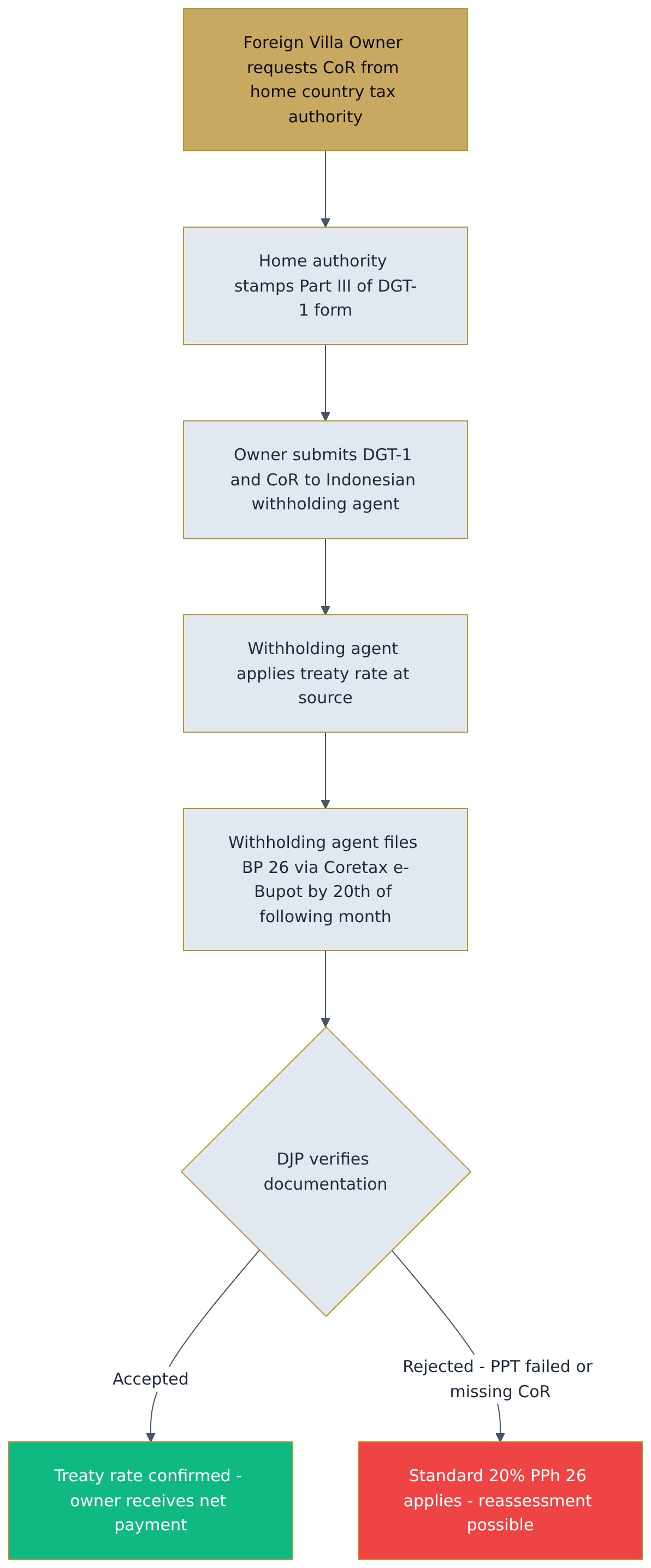
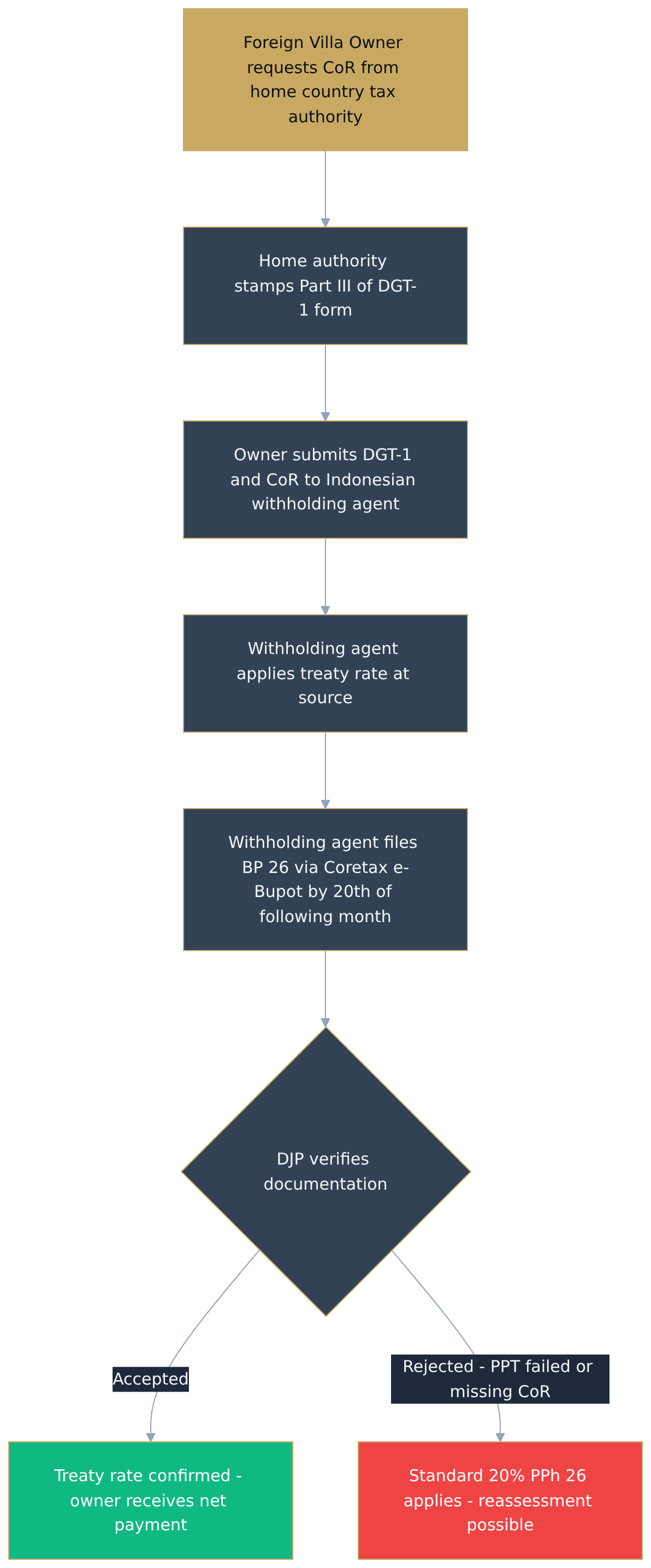
flowchart TD
    A[Foreign Villa Owner requests CoR from home country tax authority] --> B[Home authority stamps Part III of DGT-1 form]
    B --> C[Owner submits DGT-1 and CoR to Indonesian withholding agent]
    C --> D[Withholding agent applies treaty rate at source]
    D --> E[Withholding agent files BP 26 via Coretax e-Bupot by 20th of following month]
    E --> F{DJP verifies documentation}
    F -->|Accepted| G[Treaty rate confirmed - owner receives net payment]
    F -->|Rejected - PPT failed or missing CoR| H[Standard 20% PPh 26 applies - reassessment possible]
    style A fill:#c9a962,color:#0c0e14
    style G fill:#10b981,color:#fff
    style H fill:#ef4444,color:#fff
Practical Scenarios: France, UK, and Australia
Scenario 1, French Citizen, Direct Villa Rental (No PT PMA)
A French tax resident owns a villa in Seminyak generating Rp 480,000,000 gross annual rental income through Airbnb and Booking.com. The income is classified as rental income from immovable property (Article 6, France–Indonesia DTA). Article 6 grants Indonesia full taxing rights. No DTA reduction is available. The applicable rate remains PPh Final 20% for non-residents (or PPh Final 10% if the owner qualifies as an Indonesian tax resident with an NPWP). PBJT (hotel tax, 10%) is also due separately and collected from guests.
For compliance management, VillaTax calculates PPh, PBJT, and Kurs Pajak adjustments automatically for each booking, across all OTA platforms.
Scenario 2, French Citizen, PT PMA Structure, Dividend Distribution
The same French owner holds the villa through a PT PMA. The PT PMA pays corporate tax (PPh Badan) at 25% on net profit. It then distributes Rp 120,000,000 in dividends to the French shareholder. Under Article 10 of the France–Indonesia DTA, and assuming the French shareholder holds less than 25% of the PT PMA capital, the withholding rate on dividends is 15% instead of 20%. The French shareholder must provide a valid DGT-1 form with Part III stamped by the French tax authority (DGFiP). Savings: Rp 6,000,000 per distribution.
Scenario 3, Australian Citizen, PT PMA, Dividends
An Australian tax resident owns a Bali villa through a PT PMA holding at least 10% of the share capital. Under Article 10 of the Australia–Indonesia DTA, the dividend withholding rate is 10%. On a dividend of Rp 120,000,000, the withholding is Rp 12,000,000 instead of Rp 24,000,000 at the standard rate. Savings: Rp 12,000,000 per distribution. CoR must be obtained from the ATO and the DGT-1 form submitted before the dividend payment date.
Anti-Abuse Rules and Common Mistakes to Avoid
PMK 112/2025 significantly tightens anti-avoidance provisions. The following mistakes can result in treaty benefits being denied and a reassessment at the full 20% rate, with potential penalties under UU KUP.
Using a shell company in Singapore or the Netherlands without real economic substance (employees, office, decision-making) will fail the Principal Purpose Test. The DJP has issued guidance (PER-25) requiring demonstrated economic substance for entities claiming treaty benefits.
Late or missing CoR, if the CoR is not in place before the income is paid, the withholding agent must apply the standard 20% rate. Retroactive treaty claims require a refund application (restitusi) and are rarely straightforward.
Claiming Article 12 (royalties) rates on rental income, rental income is always Article 6. Attempting to reclassify it as a royalty or service fee to access a lower rate is a known DJP audit trigger.
Failure to renew the DGT form annually, the DGT form covers the year of income. A new form with a new CoR is required each year.
NPWP mismatch, if the villa owner has an Indonesian NPWP, the applicable regime may change. Consult a registered Indonesian tax consultant (Konsultan Pajak) before claiming treaty benefits.
Sources: SBR-CPA PMK 112/2025 | Farsight Bali property taxes
Compliance Checklist and Key Deadlines
Action | Deadline | Responsible Party |
|---|---|---|
Request CoR from home country tax authority | At least 8 weeks before income payment | Villa owner |
Complete and have DGT-1 Part III stamped | Before income payment date | Villa owner + home tax authority |
Submit DGT-1 and CoR to withholding agent | Before payment date | Villa owner |
Withholding agent applies treaty rate | At time of payment | Withholding agent |
File BP 26 via Coretax e-Bupot | 20th of month following payment | Withholding agent |
Retain documentation | 5 years from tax year end | Both parties |
Renew CoR and DGT form | Annually | Villa owner |
VillaTax tracks tax withholding events, payment timelines, and Coretax filing status across all bookings and income types, giving foreign villa owners a real-time compliance dashboard.
FAQ : Frequently Asked Questions
Does the France–Indonesia DTA reduce the tax on my Bali villa rental income?
No. Rental income from a villa in Bali is classified as income from immovable property under Article 6 of the France–Indonesia DTA. Under Article 6, Indonesia retains full taxing rights on such income, meaning the standard Indonesian rate applies regardless of your French tax residency. The DTA does not reduce the withholding rate on direct rental income.
What income types from a Bali villa can benefit from a reduced DTA rate?
The DTA can reduce withholding rates on dividends (Article 10), interest (Article 11), and royalties (Article 12). For most villa owners, the practical benefit arises when income is distributed as dividends from an Indonesian PT PMA company to a foreign shareholder. Rental income itself is always taxed at the Indonesian standard rate.
How long does it take to obtain a DGT form approval?
The DGT form process itself is not an approval process, the form is submitted by the withholding agent along with the BP 26 filing. The key step that takes time is obtaining the Certificate of Residence from your home country tax authority, which typically takes 4 to 8 weeks. Plan accordingly before dividend distributions or income payments.
What happens if my DTA claim is rejected by the DJP?
If the DJP rejects a DTA claim (for example because the Principal Purpose Test is not satisfied, the CoR is missing, or the income is misclassified) the standard 20% PPh 26 rate applies. The DJP can also impose penalties under Article 13 of UU KUP for underpayment, which can reach 48% of the unpaid tax in cases of negligence. Maintaining complete documentation significantly reduces this risk.
Can I manage PPh 26 withholding and DTA compliance from outside Indonesia?
Yes. Through the VillaTax platform, foreign villa owners can monitor withholding events, track Coretax compliance, upload declaration documents, and receive automated alerts for filing deadlines, without needing to be physically present in Bali. VillaTax integrates directly with 310+ OTA platforms for automated booking and tax data ingestion.
Is PMK 112/2025 already in force and does it apply to my 2025 income?
Yes. PMK 112/2025 is in force and applies to income payments subject to PPh 26 withholding from 2025 onwards. All DTA claims processed after the effective date of the regulation must comply with its requirements, including the mandatory DGT form submission, anti-abuse testing, and e-Bupot filing via Coretax.
Conclusion
Claiming DTA benefits for a Bali villa requires a precise understanding of which income type qualifies for which treaty article. Rental income from immovable property is taxed in full by Indonesia under virtually all DTAs, the DTA benefit on villa income primarily arises at the dividend distribution stage for PT PMA structures. PMK 112/2025 has tightened the administrative requirements significantly, making a properly completed DGT-1 form, a valid Certificate of Residence, and timely e-Bupot filing mandatory prerequisites for any treaty claim.
If you are a foreign villa owner and want to understand your exact tax position, calculate your PPh and PBJT obligations by booking, and monitor your Coretax compliance status, VillaTax provides an automated, multilingual tax compliance platform built specifically for Bali villa owners, agencies, and PT PMA structures. Start with a free diagnostic today.