
The debate around PBJT vs Hotel Tax vs Tourism Levy in Bali confuses even experienced villa owners, because three separate obligations get mixed into one conversation at almost every property handover, investor call, and property manager briefing. PBJT (Pajak Barang dan Jasa Tertentu) is a local tax on specific goods and services, including hospitality and food and beverage activity. Hotel tax is the older, informal name many owners still use for that same local tax category. The tourism levy is a completely different, guest-facing fee collected by the Bali provincial government from foreign visitors, unrelated to villa revenue. This guide separates the three concepts in practical terms so villa owners, property managers, and foreign investors know exactly who pays, who collects, who reports, and what belongs in a monthly compliance file. Rules, rates, and administrative processes in Indonesia evolve, so every figure below should be verified with a qualified Indonesian tax advisor or the relevant local authority before it is applied to a specific villa.
This guide explains how to automate monthly PBJT tracking, includes SEO meta descriptions for every section, and closes with a frequently asked questions section covering the most common villa tax concerns in Bali.
What Is PBJT and Why Does It Matter for Bali Villas?
PBJT is a local (regional) tax charged on certain categories of goods and services in Indonesia, and accommodation, food, and beverage activity typically fall inside this category when a property is operated commercially rather than used purely as a private residence. For a villa that accepts paying guests, whether through Airbnb, Booking.com, a villa management company, or direct bookings, PBJT is generally not optional simply because the property is a private house rather than a branded hotel.
The core distinction that trips up owners is that PBJT is charged on gross revenue from the guest-facing transaction, before any deduction of costs, commissions, or profit. Income tax, by contrast, applies to net profit after allowable deductions. A villa can therefore owe PBJT on a booking even in a month where the owner's actual profit is thin or negative once cleaning costs, OTA commissions, and staff wages are subtracted. This is precisely why revenue records — not just profit calculations — are the foundation of villa tax compliance.
Because PBJT sits at the local government level (regency or city, such as Badung, Gianyar, or Denpasar), the exact administrative process, payment portal, and reporting cadence can differ from one jurisdiction to the next, even within Bali. A villa in Canggu and a villa in Ubud may technically fall under the same national PBJT framework but interact with different local tax offices.
Key Takeaway: PBJT is charged on the guest transaction itself, calculated on gross revenue, and administered at the local level — it is not the same calculation, timing, or authority as income tax on villa profit.
Is Hotel Tax Still Relevant or Has PBJT Replaced the Term?
Many villa owners, agents, and even some accountants still say "hotel tax" out of habit, because the older regional tax law referred to a hotel tax and a restaurant tax as separate categories before the terminology was consolidated. In everyday conversation on the ground in Bali, "hotel tax," "accommodation tax," and "PBJT" are frequently used interchangeably to describe the same underlying local levy on accommodation revenue.
What matters far more than the label is the practical obligation behind it: a property generating accommodation revenue in Bali is expected to interact with a local tax mechanism on that revenue, regardless of whether the person explaining it to you calls it "hotel tax" or "PBJT." Villa owners should not assume that hearing the older term means the obligation has disappeared, and should not assume that hearing the newer term means the rules are identical everywhere.
Because implementation details (registration requirements, rates, and filing frequency) are set at the regency or city level, the safest practice is always to confirm the current local requirement directly with the relevant local government office or a licensed Indonesian tax advisor rather than relying on generic terminology from another region or from outdated blog posts.
Comparison: old terminology vs current reporting reality
Aspect | "Hotel Tax" (older term) | PBJT (current administrative reference) |
|---|---|---|
Common usage | Still widely used informally by agents and owners | Increasingly used in official local regulations |
Underlying obligation | Same category of local accommodation levy | Same category of local accommodation levy |
Scope | Historically hotels and restaurants named separately | Consolidated goods and services category |
Administered by | Local (regency/city) government | Local (regency/city) government |
Practical action for owners | Confirm current local requirement | Confirm current local requirement |
What Is the Bali Tourism Levy?
The Bali tourism levy, officially the foreign tourist levy (Pungutan Wisatawan Asing), is a one-time, per-person fee charged directly to foreign visitors entering Bali, currently set at IDR 150,000 under Bali Provincial Regulation No. 6 of 2023, and in effect since February 2024. It is paid once per trip through the official Love Bali platform, not per night and not per booking, and the funds are directed toward cultural preservation, environmental protection, and tourism infrastructure across the island.
This levy has nothing to do with villa revenue, PBJT, or the villa owner's income. It is a charge collected from the guest personally, in the guest's own capacity as a visitor to Bali, independent of where they stay or how they booked their trip. A guest who never books a villa at all — someone staying with friends, or transiting through — still owes the same levy if they are a foreign tourist entering the island.
Villa owners are not the taxpayer for this levy and are not required to remit it to the Bali provincial government on the guest's behalf. However, understanding it matters for guest communication: many international guests confuse the tourism levy with an accommodation surcharge, assume the villa should collect it, or arrive unaware that they owe it separately. Clear, proactive messaging at booking confirmation and check-in reduces friction and avoids guests mistakenly believing the villa itself charged them an unexplained fee.
Compliance Tip: Add one line to your booking confirmation or welcome message clarifying that the Bali tourism levy (IDR 150,000 per person) is a separate government fee paid directly by the guest through the official Love Bali platform, unrelated to the villa's own rates or taxes.
PBJT vs Hotel Tax vs Tourism Levy: The Core Differences
Criteria | PBJT | Hotel Tax (legacy term) | Bali Tourism Levy |
|---|---|---|---|
Legal nature | Local tax on specific goods and services | Same obligation, older terminology | Provincial visitor fee (Perda No. 6/2023) |
Who pays | The villa business, based on guest revenue | The villa business, based on guest revenue | The foreign guest personally |
Who collects | Villa collects as part of pricing, remits to local authority | Villa collects as part of pricing, remits to local authority | Bali provincial government via Love Bali |
Who reports | Villa owner or manager, to the local tax office | Villa owner or manager, to the local tax office | Not a villa reporting obligation |
What triggers it | Commercial accommodation/F&B revenue | Commercial accommodation/F&B revenue | Foreign tourist entry into Bali |
Relates to villa revenue | Yes, directly | Yes, directly | No |
Relates to the guest personally | Indirectly (embedded in price) | Indirectly (embedded in price) | Yes, directly and personally |
Appears in villa accounting | Yes, as a tax line item on revenue | Yes, as a tax line item on revenue | No, unless the villa voluntarily assists guests |
Coretax relevance | Indirect, via income tax and national reporting | Indirect, via income tax and national reporting | None |
Compliance risk for owners | High if unreported or under-recorded | High if unreported or under-recorded | Low, since it is not the owner's obligation |
How These Taxes Affect Villa Owners, Managers and Foreign Investors
The practical weight of PBJT, income tax, and the tourism levy differs by ownership structure. An Indonesian individual owner renting out a single villa faces a simpler reporting profile than a foreign-owned PT PMA operating several properties, but the underlying obligations do not disappear for either.
Owner Type | PBJT Relevance | Income Tax Complexity | Tourism Levy Involvement | Typical Risk Area |
|---|---|---|---|---|
Indonesian individual owner | Applies if operated commercially | Personal income tax on rental profit | None (guest pays) | Under-reporting direct bookings |
Foreign investor (personal name) | Applies same as above | Residency status affects rate | None | Ambiguous legal ownership structure |
PT PMA structure | Applies to corporate revenue | Corporate income tax (PPh Badan) on profit | None | Mixing corporate and personal accounts |
Pondok Wisata operator | Applies under local accommodation rules | Depends on business registration | None | Licensing and tax registration mismatch |
Villa management company | Collects/administers on owner's behalf | Reports management fee income separately | May assist with guest communication only | Unclear split between owner and manager revenue |
Nominee-style arrangement | Applies to whoever holds legal/beneficial revenue | High legal and tax exposure | None | Legal ambiguity compounding tax risk |
Multi-villa operator | Applies per property, aggregated reporting risk | Consolidated profit reporting complexity | None | Inconsistent records across properties |
How Airbnb, Booking.com, Agoda and Direct Bookings Create Reporting Complexity
Online travel agencies simplify guest acquisition but complicate tax reporting, because the number that lands in the owner's bank account is a net payout, not the gross booking value a guest actually paid. Platform commissions, payment processing fees, cleaning fees, service fees, and currency conversion spreads are all subtracted before the owner sees a deposit, and refunds or cancellations can further distort the picture across a given month.
A villa that reports only the net OTA payout as its revenue is, in effect, under-reporting the gross transaction value that local tax obligations are typically calculated against. The gap between gross booking value and net payout needs to be reconstructed from OTA reporting dashboards, not assumed away, and this becomes harder still when a villa also receives direct bookings paid by bank transfer or cash, split payments between an owner and a management company, or bookings partially prepaid and partially settled on arrival.
OTA dashboards are a useful data source, but they should not replace a proper internal accounting record. Export the full booking-level detail — not just the payout summary — every month, and reconcile it against actual bank deposits. For villa businesses already juggling multiple structures across owner and manager accounts, a villa compliance platform built specifically for Bali accommodation revenue can help standardize this reconciliation instead of rebuilding a spreadsheet from scratch every month.
PBJT and Villa Revenue: What Should Be Tracked Every Month?
A clean monthly record is the single biggest factor separating villas that pass an audit smoothly from those that scramble to reconstruct a year of bookings after the fact.
Monthly PBJT Tracking Checklist
Data Point | Why It Matters |
|---|---|
Booking source (OTA name or direct) | Establishes which reconciliation applies |
Guest name or booking ID | Traceability for any single transaction |
Stay dates | Ties revenue to the correct reporting period |
Gross rental amount | Base figure for local tax calculation |
Cleaning fee | Often part of taxable gross revenue |
Service fee | Often part of taxable gross revenue |
Discounts applied | Explains variance from listed rate |
Refunds issued | Must be documented, not just netted silently |
OTA commission | Explains the gap between gross and net |
Net payout received | The actual cash figure, for bank reconciliation |
Payment date | Confirms timing against the reporting period |
Bank account received into | Confirms which entity actually received funds |
Invoice or receipt issued | Supporting document for the transaction |
Local tax category applied | PBJT or other applicable local category |
Supporting documents filed | Audit trail if a local office requests evidence |
Coretax, Local Taxes and Digital Compliance
Coretax is part of Indonesia's broader tax digitalization effort at the national level, run by the Directorate General of Taxes, and it is primarily oriented around national tax obligations such as income tax and VAT (PPN) rather than local, regency-level taxes like PBJT. Villa owners should not assume that registering or filing correctly in Coretax automatically satisfies a separate, local PBJT obligation administered by a regency or city government — the two systems sit at different levels of government and serve different reporting purposes.
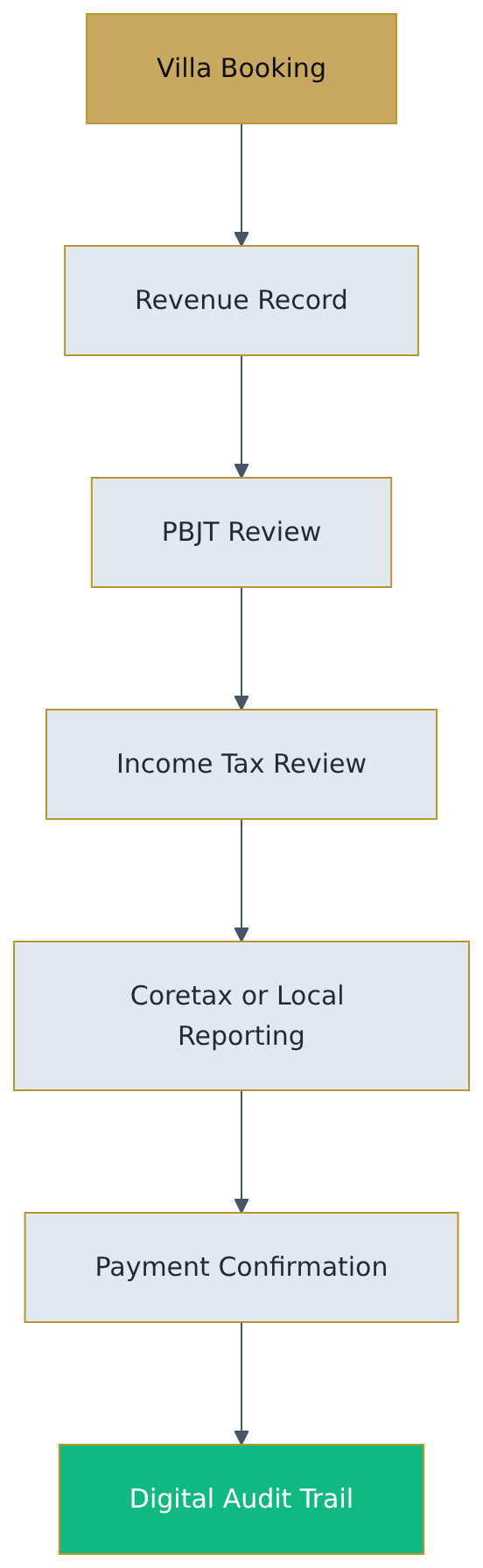
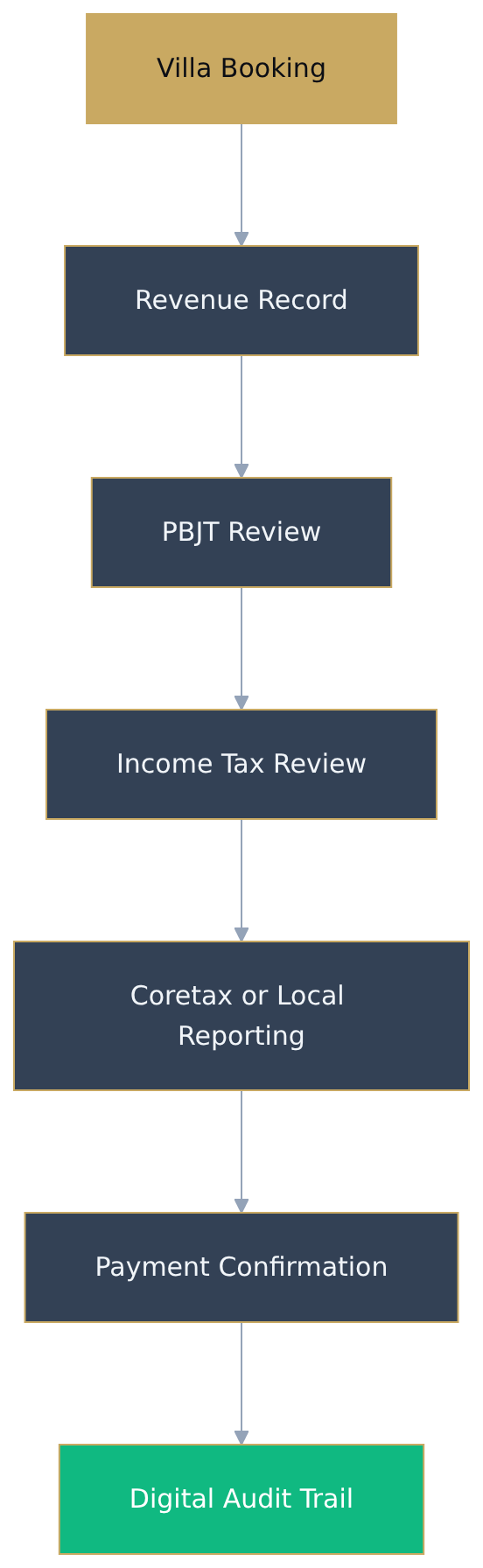
What Coretax does provide is greater visibility for national tax authorities into a taxpayer's overall financial activity, which makes it more important, not less, for villa revenue records to be internally consistent across every system a villa touches: OTA dashboards, bank statements, local tax filings, and national tax filings. A digital audit trail that connects a booking to a bank deposit to a tax filing is the practical output every villa should be able to produce on request.
flowchart TD
    A[Villa Booking] --> B[Revenue Record]
    B --> C[PBJT Review]
    C --> D[Income Tax Review]
    D --> E[Coretax or Local Reporting]
    E --> F[Payment Confirmation]
    F --> G[Digital Audit Trail]

    style A fill:#c9a962,color:#0c0e14
    style G fill:#10b981,color:#fff
Common Mistakes Bali Villa Owners Make With PBJT, Hotel Tax and Tourism Levy
Treating the tourism levy as a substitute for villa tax obligations — it is a separate, guest-paid fee and does not cover PBJT or income tax on villa revenue.
Confusing PBJT with income tax — PBJT is calculated on gross revenue; income tax is calculated on net profit.
Reporting only the net OTA payout instead of the gross booking value, which understates taxable revenue.
Ignoring direct bookings paid by bank transfer, cash, or messaging apps, which are just as reportable as OTA bookings.
Mixing personal and villa bank accounts, making reconciliation and audit response far harder.
Keeping passport and guest ID records but not revenue records, which solves a licensing problem but not a tax one.
Assuming Airbnb or Booking.com handle Indonesian local taxes automatically — platforms handle their own commissions and, in some markets, certain remittances, but villa owners should verify what is and is not covered locally.
Not separating owner payout from management fee in the books, which blurs who earned what and complicates both parties' tax positions.
Using WhatsApp as the sole document archive, with no backup, structured folder, or export.
Not keeping proof of payment for local tax remittances, leaving no evidence if a filing is later questioned.
Not checking regency-specific requirements, and assuming rules identical to a different area of Bali apply locally.
Using old "hotel tax" terminology without confirming current practical obligations in the specific jurisdiction.
Having no audit-preparation routine, so a request for records triggers a scramble rather than an export.
Under-documenting refunds and cancellations, leaving net revenue figures unexplained.
Failing to reconcile monthly revenue across OTA dashboards, bank statements, and internal books.
Assuming a Pondok Wisata license alone satisfies tax obligations, when licensing and taxation are related but distinct processes.
Delaying bookkeeping until year-end, which makes monthly PBJT-style obligations nearly impossible to reconstruct accurately.
Not briefing staff or property managers on which documents must be retained for every stay.
Ignoring currency conversion discrepancies on international payouts, which can create small but cumulative reporting gaps.
Assuming one system (Coretax, an OTA dashboard, or a manager's spreadsheet) replaces the need for a consolidated compliance file.
Manual Compliance vs Villa Tax
Compliance Area | Manual Spreadsheet | Accountant Only | Villa Manager Only | Villa Tax |
|---|---|---|---|---|
PBJT tracking | Manual, error-prone | Periodic, not real-time | Inconsistent across properties | Structured, continuous tracking |
Hotel tax terminology clarification | Owner must research alone | Available on request | Rarely addressed | Built into guidance materials |
Tourism levy guest notes | Not typically included | Not typically included | Sometimes included informally | Standardized guest messaging support |
OTA revenue reconciliation | Manual export and matching | Only at filing time | Partial, platform-dependent | Centralized reconciliation workflow |
Direct booking records | Easily missed | Depends on owner input | Depends on manager diligence | Structured intake for all sources |
Tax document storage | Scattered files | With the accountant only | With the manager only | Centralized document management |
Coretax preparation | Owner responsibility alone | Accountant-led | Not typically involved | Organized supporting data for the advisor |
Multi-villa dashboard | Not available | Not typically offered | Rare, manual | Purpose-built for multiple properties |
Audit trail | Fragmented | Accountant's own records only | Rare | Consolidated digital trail |
Owner visibility | Low, requires manual review | Periodic only | Depends on manager reporting | Ongoing visibility |
Monthly reporting workflow | Manual and inconsistent | Often quarterly or annual | Informal | Structured monthly workflow |
Supporting documents | Scattered | With accountant | With manager | Centralized and organized |
Villa Tax does not file taxes automatically or replace a licensed Indonesian tax advisor. It organizes revenue records, OTA reconciliation, and supporting documentation so that owners, managers, and accountants are working from the same consistent data set rather than three separate, disconnected records.
Practical Step-by-Step Compliance Workflow for Villa Managers
Step 1: Map Every Booking Source
List every channel that can generate villa revenue — each OTA, direct website bookings, WhatsApp inquiries converted to bookings, walk-ins, and any third-party agent — so nothing is structurally excluded from the monthly record before tracking even begins.
Step 2: Record Gross Revenue Before Deductions
Log the full amount the guest was charged, before OTA commission, payment processing fees, or any other deduction, since local tax obligations are generally calculated on this gross figure rather than the net payout.
Step 3: Separate PBJT, Income Tax and Tourism Levy Concepts
Keep three distinct mental (and literal, in your spreadsheet or platform) columns: local tax on revenue, national income tax on profit, and the guest-paid tourism levy that never touches villa accounts at all.
Step 4: Reconcile OTA Payouts With Bank Deposits
Match every payout received in the bank against the corresponding booking-level export from the OTA, flagging any unexplained gap immediately rather than at year-end.
Step 5: Store Supporting Documents
Keep booking confirmations, invoices, payout statements, and refund records in a structured, backed-up location — not solely inside a messaging app thread.
Step 6: Prepare Monthly Reporting Files
Close out each month with a summary file: total gross revenue, applicable local tax calculation, OTA commission total, net payout total, and any exceptions or refunds.
Step 7: Review With a Tax Professional
Have a qualified Indonesian tax advisor review the monthly or quarterly file, particularly before any change in ownership structure, scale of operations, or local regulation.
Step 8: Keep a Digital Audit Trail
Ensure every figure in the monthly file can be traced back to a source document — a booking confirmation, bank statement line, or payout report — so an audit request can be answered with evidence rather than reconstruction.
Document Retention Guide for PBJT and Villa Tax Compliance
Document | Why It Matters | Who Should Keep It | Suggested Retention Practice |
|---|---|---|---|
OTA booking confirmations | Source evidence for each transaction | Owner or manager | Retain digitally; verify local minimum period with an advisor |
Invoices | Formal record of amounts charged | Owner or accountant | Retain digitally; verify local minimum period |
Guest receipts | Supports revenue and refund tracking | Owner or manager | Retain alongside booking records |
Payment proofs | Confirms actual funds received | Owner | Retain with bank statements |
Bank statements | Core reconciliation document | Owner or accountant | Retain per bank and advisor guidance |
Refund records | Explains revenue reductions | Owner or manager | Retain with the original booking record |
Cancellation records | Explains missing expected revenue | Owner or manager | Retain with the original booking record |
Owner payout statements | Confirms owner vs manager split | Owner and manager | Retain in a shared, structured file |
Management fee invoices | Confirms manager's own reportable income | Manager | Retain separately from owner revenue |
Local tax payment confirmations | Direct evidence of PBJT compliance | Owner or accountant | Retain per local office guidance |
Coretax filing confirmations | Evidence of national tax compliance | Owner or accountant | Retain per DGT guidance |
Tourism levy communication notes | Shows proactive guest clarity, not a tax filing | Manager | Optional, for guest service records |
Guest registration documents | Supports licensing, not tax, obligations | Manager | Retain per licensing authority guidance |
Property license documents | Confirms legal operating basis | Owner | Retain for the license's full validity period |
Accountant review notes | Documents professional guidance received | Owner | Retain alongside the relevant filing period |
Exact legally required retention periods vary and should always be confirmed with a licensed Indonesian tax advisor or the relevant local authority rather than assumed from general practice.
How Villa Tax Simplifies PBJT, Hotel Tax and Tourism Levy Compliance
Villa owners juggling PBJT, income tax considerations, OTA reconciliation, and guest-facing tourism levy questions rarely have a single place where all of this comes together. A villa compliance platform can centralize tax documents, categorize revenue by source, reconcile OTA payouts against bank deposits, and generate monthly owner reports so that the underlying data is ready when a tax advisor or Coretax filing needs it — without claiming to file taxes automatically or replace a licensed consultant.
For operators managing several properties, multi-villa compliance dashboards reduce the risk of one property's records falling out of sync with the rest of the portfolio, while structured guest and owner documentation keeps refund notes, payout statements, and licensing files in one place instead of scattered across email and chat threads. Owners exploring the wider OPERIUM product ecosystem can also review adjacent tools such as KYC-Flow for guest and partner verification, Contract-Sign for management agreements, Partner-Portal for branded owner-facing reporting, Proof-of-Service for documenting completed compliance tasks, and Tax-Shield for broader tax document organization needs.
None of these tools substitute for registering correctly with the relevant local tax office, filing through Coretax where applicable, or working with a licensed Indonesian tax advisor. Their role is preparation, organization, and visibility — the groundwork that makes professional advice faster and more accurate.
FAQ — Frequently Asked Questions
What is PBJT in Bali?
PBJT (Pajak Barang dan Jasa Tertentu) is a local tax applied to specific goods and services in Indonesia, including hospitality and food and beverage activity. For villas operated commercially, it typically applies to guest revenue at the local, regency-level, separate from national income tax.
Is PBJT the same as hotel tax?
PBJT and "hotel tax" generally describe the same underlying local levy on accommodation revenue, with "hotel tax" being the older, informal term still used by many owners and agents, while PBJT reflects the more current administrative category used in local regulation.
Is the Bali tourism levy the same as villa tax?
No, the Bali tourism levy is a separate, one-time IDR 150,000 fee paid personally by foreign tourists entering Bali, unrelated to villa revenue, PBJT, or income tax owed by the villa owner or operator.
Do Bali villa owners have to collect PBJT?
Villas operated commercially generally interact with local PBJT obligations on guest revenue, though the exact registration and payment process depends on the regency or city, so owners should confirm requirements with the local tax office or a qualified advisor.
Who pays the Bali tourism levy?
The foreign tourist personally pays the Bali tourism levy, once per trip, through the official Love Bali platform, regardless of where they stay or how their trip was booked.
Does Airbnb collect PBJT for villa owners?
Airbnb and similar platforms primarily manage their own commissions and, in some markets, certain remittances, but villa owners should not assume local PBJT obligations are automatically satisfied by the platform without confirming this locally.
Should villa owners report gross revenue or net OTA payouts?
Local tax obligations are typically calculated on gross guest revenue before OTA commissions and fees are deducted, so relying only on the net payout figure can understate what should be reported.
Does PBJT apply to direct bookings?
Yes, direct bookings paid by bank transfer, cash, or messaging apps generally fall under the same local tax consideration as OTA bookings, since the obligation relates to the commercial accommodation activity itself, not the booking channel.
What records should a Bali villa owner keep?
Owners should keep booking confirmations, gross and net revenue figures, refund and cancellation records, bank statements, payout statements, and any local tax payment confirmations, ideally centralized rather than scattered across multiple apps.
How does Coretax affect villa tax compliance?
Coretax is Indonesia's national tax digitalization platform, primarily relevant to income tax and VAT reporting, and does not replace separate, local PBJT obligations administered at the regency or city level.
Can a foreign villa owner be liable for Indonesian tax?
Foreign investors operating villa revenue in Indonesia, whether personally or through a structure like a PT PMA, can have Indonesian tax obligations, and residency status affects how income tax applies, so professional advice is essential before assuming any position.
Is a Pondok Wisata license related to tax compliance?
A Pondok Wisata license relates to legal operating permission for small-scale tourist accommodation and is a separate process from tax registration and reporting, though both are typically necessary for lawful villa operation.
What happens if a villa ignores PBJT?
Ignoring local tax obligations on commercial accommodation revenue can create compliance risk, including potential penalties or back-payment demands, so villa owners should confirm and address their local PBJT position rather than assume it does not apply.
Can Villa Tax replace an accountant?
No, Villa Tax organizes revenue records, documentation, and reconciliation to support compliance, but it does not replace a licensed Indonesian tax advisor, accountant, or lawyer for filing, interpretation, or legal decisions.
How can Villa Tax help with PBJT and tourism levy confusion?
Villa Tax centralizes revenue tracking, OTA reconciliation, and supporting documentation, and provides guest-communication clarity on the tourism levy, so owners, managers, and accountants share one consistent record instead of three disconnected ones.
Conclusion
PBJT, hotel tax terminology, and the Bali tourism levy describe three genuinely different things: a local tax on villa revenue, an older name for that same obligation, and a personal, guest-paid provincial fee that has nothing to do with villa accounting. Villa owners who understand who pays, who collects, and who reports each one are far better positioned to reconcile OTA payouts against direct bookings, keep a clean audit trail, and avoid the twenty common mistakes outlined above. A villa tax compliance platform can help centralize that documentation and reporting preparation, but it works alongside — never instead of — a qualified Indonesian tax advisor, the relevant local tax office, and the Directorate General of Taxes where national obligations apply. Rules and rates can change, so always verify the current requirement with a competent authority before relying on any figure in this guide. Explore Villa Tax to see how PBJT tracking, OTA reconciliation, and Coretax preparation can be organized in one place. -e