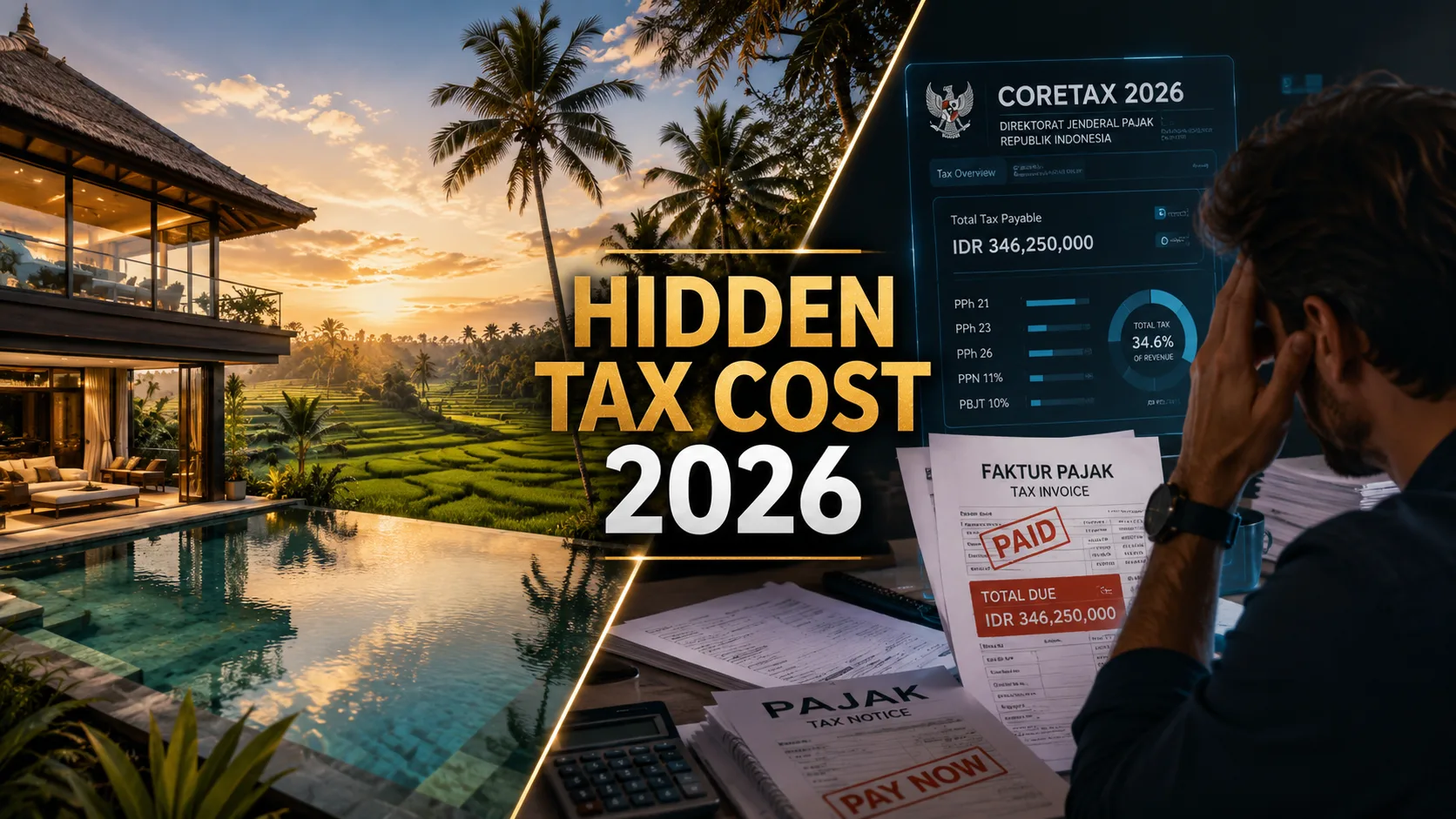
You found the villa of your dreams in Seminyak: 350,000 euros, a pool, rice field views, and a rental yield of 12% displayed on the agency's brochure. You signed a letter of intent. Then came the first Indonesian tax invoice — and you realized nobody had prepared you for what was coming. This guide breaks down the real fiscal cost of buying and operating a villa in Bali, frequently asked questions included, from signature to your first rented night. Indonesia profoundly reformed its tax system in 2025-2026 through the Coretax platform and PMK 81/2024, making any guide written before 2024 obsolete. We walk through the 4 fiscal phases of your acquisition: purchase, ownership, rental, and the Coretax era.
Why a Foreigner Cannot "Simply Buy" a Villa in Bali
The first thing to understand is that Indonesian property law is not designed with foreign buyers in mind. The Indonesian Agrarian Law (UUPA 1960) reserves the right of full ownership — Hak Milik — to Indonesian citizens only. A foreigner who attempts to circumvent this through a local nominee faces criminal exposure under the same law. Understanding this legal baseline is essential before discussing any tax.
The Indonesian Land Title System
Indonesia operates a tiered land title system that directly determines what rights you hold and what taxes apply:
Hak Milik is the highest title, equivalent to freehold. It is exclusively available to Indonesian citizens. If you are a foreign national, you cannot hold Hak Milik under any legal structure in your personal name.
Hak Pakai (Right of Use) is the title available to foreign individuals with a valid KITAS or KITAP residency permit. It grants a right of use typically for 25 years, renewable twice for additional 20-year periods, giving a theoretical maximum of 65 years. It is non-transferable in the same way as Hak Milik, and the land reverts if you lose your residency status. The fiscal treatment of Hak Pakai transactions is increasingly scrutinized under Coretax 2026.
Hak Guna Bangunan (Right to Build) is held by Indonesian legal entities — including PT PMA foreign investment companies. HGB is the most common title used in villa investment structures and grants a 30-year right renewable for 20 years. It is the title underlying most PT PMA villa operations.
The Three Structures and Their Real Fiscal Reality
Foreign buyers in Bali operate through one of three arrangements, each with a radically different fiscal and legal profile:
The Nominee Structure remains the most commonly encountered and the most dangerous. A foreign buyer puts funds through an Indonesian local who holds the Hak Milik title "on their behalf." This arrangement violates the UUPA, is considered illegal under Indonesian law, and has been actively prosecuted since 2023 following a series of high-profile asset seizures in Badung regency. No reputable tax advisor will defend this structure. The fiscal exposure is total: there is no legal basis for the foreign party to claim the asset, repatriate income, or invoke any Double Taxation Agreement (DTA).
Hak Pakai in Personal Name is legal but severely limited. It requires an active residency permit, restricts the holder to a single property, cannot be used for commercial rental activity through an OTA platform (which triggers PKP registration obligations for the holder), and creates complex PPh 26 withholding scenarios when income flows to a non-resident. For an investor primarily located in Europe, it creates more fiscal complications than it solves.
PT PMA (Perseroan Terbatas Penanaman Modal Asing — Foreign Investment Limited Liability Company) is the only structure that provides a legally sound foundation for commercial villa operations with proper fiscal optimization. The PT PMA holds the HGB title, operates the rental business, employs staff, registers for all applicable taxes, and distributes dividends to its foreign shareholders — subject to withholding tax at rates that can be reduced through applicable DTAs. This is the structure from which all fiscal calculations in this guide proceed.
The Setup Cost of a PT PMA: The First Tax Expense Nobody Budgets
Establishing a PT PMA is not a one-time legal formality. It is a fiscal commitment with recurring costs:
Formation costs include notarial fees for the deed of establishment, registration with the OSS (Online Single Submission) system via BKPM, DJP tax number (NPWP Badan) registration, and municipal business license (NIB). Depending on the notary and the level of assistance, total formation costs range from 3,000 to 6,000 euros.
Minimum paid-up capital for a standard PT PMA in property management (KBLI 68100/68200) is typically 10 billion IDR (approximately 600,000 euros) as the stated capital requirement under BKPM regulation — though actual paid-in capital requirements in practice are negotiable with legal counsel. This capital does not "disappear" — it represents the company's declared investment value.
Annual compliance costs include quarterly LKPM (Investment Activity Reports) submissions, annual SPT Tahunan Badan corporate tax returns, monthly PPh 21 payroll declarations if staff are employed, monthly PBJT declarations to the Badung Revenue Office, and monthly or quarterly PPN filings if the company is PKP-registered. Professional accounting fees for this compliance package range from 1,500 to 3,000 euros per year through a reputable local tax consultant or through a platform like VillaTax.
Phase 1 — Acquisition: The Taxes at the Moment of Purchase
The purchase phase generates the largest single cash outlay outside the purchase price itself. Buyers who only budget for the property price are systematically surprised by what Indonesian tax law requires at closing.
BPHTB: The Indonesian Property Transfer Tax at 5%
The Bea Perolehan Hak atas Tanah dan Bangunan (BPHTB) is the property acquisition duty paid by the buyer at the time of transfer. It is governed by Law No. 28 of 2009 and its subsequent implementing regulations.
The tax base is the higher of (a) the agreed transaction price, or (b) the NJOP (Nilai Jual Objek Pajak — Government Assessed Value) of the property. Since the NJOP of prime Bali land has been aggressively updated since 2022, the days of declaring a transaction at a fraction of its real value are effectively over under Coretax.
The rate is 5% applied to the tax base after a deduction of NPOPTKP (the non-taxable threshold), which in Badung regency stands at approximately 60 million IDR (roughly 3,500 euros). On a 500,000 euro acquisition, the effective BPHTB liability is approximately 24,800 euros.
Payment must be made to the Badung Revenue Office before the PPAT can complete the AJB deed. Late payment penalties begin immediately after the AJB date.
PPh Final 2.5%: What the Seller Pays and Why It Affects You
Under Government Regulation PP 34/2016, the seller of a property in Indonesia must pay PPh Final at 2.5% of the gross transaction value on the date of transfer. This is the seller's obligation — but in practice, it is invariably reflected in the negotiated price.
When the seller is a PT, it declares and pays this PPh Final through its Coretax account before the AJB signing. When the seller is an individual Indonesian citizen selling a non-simple property, the same 2.5% applies (reduced to 1% for simple housing under different regulations not applicable here).
For the buyer, the practical consequence is that any seller pricing their villa at market value is factoring in their 2.5% PPh obligation. On a 500,000 euro transaction, this embedded cost amounts to approximately 12,500 euros — a figure worth including in your true acquisition cost modeling.
Notarial Fees, PPJB and AJB: The Indonesian Legal-Fiscal Sequence
Indonesian property transactions proceed in two binding instruments:
The PPJB (Perjanjian Pengikatan Jual Beli — Conditional Sale Agreement) is the preliminary agreement. It binds both parties to the transaction at the agreed price and conditions but does not transfer the title. Stamp duty (Bea Meterai) applies at 10,000 IDR per page. It is signed before the PPAT but does not require full regulatory clearance.
The AJB (Akta Jual Beli — Deed of Sale and Purchase) is the definitive title transfer instrument, executed before a PPAT (Pejabat Pembuat Akta Tanah — Land Deed Official, a specialized notary). The PPAT verifies that BPHTB has been paid, that PPh Final has been declared by the seller, that there are no encumbrances on the title, and that all parties have valid tax numbers (NPWP or NITKU for foreign entities).
PPAT fees are regulated at a maximum of 1% of the transaction value for transactions above 1 billion IDR, though in practice they are negotiated downward for high-value transactions. On a 500,000 euro transaction, expect 3,000 to 5,000 euros in PPAT fees.
Since the fiscal tightening of 2024, declaring a transaction below its real market value in the AJB creates immediate exposure to a Coretax-generated reassessment notice. The DJP has access to bank transfer records, and any declared price materially below the actual wire transfer is automatically flagged.
Full Acquisition Cost Summary on a 500,000 Euro Villa
Cost Item | Rate | Amount (EUR) | Payer |
|---|---|---|---|
Purchase price | — | 500,000 | Buyer |
BPHTB (property transfer tax) | 5% | ~24,800 | Buyer |
PPh Final on sale (seller cost, typically passed through) | 2.5% | ~12,500 | Seller / reflected in price |
PPAT notarial fees | ~0.7% | ~3,500 | Buyer |
PT PMA formation (if not yet established) | fixed | 3,000–6,000 | Buyer |
HGB title registration (BPN) | fixed | ~500 | Buyer |
Total actual outlay | ~544,800–547,800 | ||
Overhead above listed price | +9% to +10% |
The effective entry ticket is consistently 8% to 12% above the listed price for buyers who have not pre-established a PT PMA. This gap is the single most common source of post-purchase friction for foreign investors.
Phase 2 — Ownership: What You Pay Even if You Never Rent
Many investors assume that fiscal obligations only arise when the villa generates income. This is incorrect. Even a "dormant" PT PMA with an unoccupied villa carries mandatory annual costs.
PBB: The Indonesian Property Tax
The Pajak Bumi dan Bangunan (PBB) is the Indonesian equivalent of a property tax, levied annually by the local government. In Badung regency — where the majority of investment-grade villas are located — rates range from 0.1% to 0.3% of the NJOP, tiered by value bracket.
For a villa with an NJOP of 5 billion IDR (approximately 290,000 euros), annual PBB would range from 5 million to 15 million IDR (290 to 870 euros). While modest compared to European property taxes, unpaid PBB creates a lien on the title and can block any future transaction or renewal of the HGB.
The PBB invoice is issued by the Badung Revenue Office (BPKPD Badung) each year and must be paid before 31 October.
Annual PT PMA Compliance Obligations Even Without Revenue
A PT PMA that holds a villa but generates no rental income in a given year is not exempt from its compliance obligations. The following must be filed regardless of activity level:
SPT Tahunan Badan (Annual Corporate Tax Return): Filed by 30 April each year for the prior fiscal year. Even a zero-revenue return must be submitted with a balance sheet and income statement. Failure to file triggers administrative penalties of 1 million IDR per late return.
LKPM Reports: Investment Activity Reports are filed quarterly (January, April, July, October) with BKPM/OSS. Late or missing LKPM reports can result in the suspension of the company's business license (NIB).
Monthly VAT Returns: If the PT PMA is PKP-registered, monthly SPT PPN must be filed even in zero-activity months.
BPJS: If the PT PMA employs any staff — including a manager, cleaning staff, or security — BPJS Kesehatan and BPJS Ketenagakerjaan contributions are mandatory from the first employee.
The true annual holding cost for a zero-revenue PT PMA is approximately 15 million to 20 million IDR in compliance fees alone (870 to 1,160 euros), before any accounting firm fees.
The Coretax Dormancy Trap
Since January 2026, the DJP's Coretax system cross-references PT PMA activity declarations against external data sources including OTA platforms (Airbnb, Booking.com, Agoda, Traveloka), bank incoming wire transfers, and Siskoharlat immigration check-in data.
A PT PMA that declares "no rental activity" while the villa owner's property appears live on Airbnb with bookings will receive an automated notice from the DJP within weeks. The gap between declared income and OTA-generated income is the primary audit trigger for villa operators in Bali as of 2026.
Phase 3 — Rental: When the Villa Generates Income, Taxes Multiply
Once your villa enters the rental market — whether through OTAs or direct bookings — the number of applicable taxes increases significantly.
PBJT at 10%: The Tourism Local Tax That Replaced Hotel PPN
The Pajak Barang dan Jasa Tertentu (PBJT) is a local government tax on tourism accommodation services, introduced by Law No. 1 of 2022 (HKPD Law) which replaced the previous Hotel and Restaurant Tax (Pajak Hotel dan Restoran) regime.
Rate: 10% of the value of each stay, collected from the guest.
Collection mechanism: The PT PMA (or OTA platform acting as tax collector) collects PBJT on each transaction. OTAs operating in Indonesia — Airbnb, Booking.com, Agoda, Traveloka — are registered as PBJT collectors and remit the tax directly to the Badung Revenue Office. If bookings come through direct channels not covered by an OTA collector, the PT PMA must collect and remit PBJT independently.
Declaration frequency: Monthly, submitted to the Badung Revenue Office (BPKPD Badung) by the 15th of the following month.
Pass-through nature: PBJT is nominally collected from the guest and remitted to the government. However, platforms often absorb it into displayed pricing, and its practical effect on occupancy rates and effective yield must be modeled carefully.
For the full interaction between OTA platforms and PBJT collection, see the VillaTax Airbnb/Booking/Agoda Compliance Guide.
PPh Final 10% vs. PPh Badan 22%: The Structural Tax Choice
This is the most consequential fiscal decision you will make for your villa PT PMA. Two regimes are available:
PPh Final 10% under Government Regulation PP 94/2010 and its successors applies to rental income from land and buildings. It is a final tax on gross rental revenue — no deductions are allowed, but the obligation is discharged with payment. At 10%, it is paid monthly via e-billing through Coretax.
PPh Badan 22% (or 20% for companies meeting certain listing criteria) is the standard corporate income tax on net profit after deductible expenses. It allows deduction of depreciation on the villa building, staff costs, maintenance, marketing fees, insurance, and professional fees. Where operating costs are high relative to revenue, PPh Badan can be more efficient.
Break-even guidance: Below approximately 80,000 euros of gross annual revenue with moderate expenses, PPh Final 10% is typically simpler and often less expensive. Above 100,000 euros with documented expenses exceeding 40% of revenue, PPh Badan may produce lower total tax. The VillaTax fiscal engine calculates this comparison in real time for your specific revenue and expense structure. For a full comparison, see the PPh Final vs. PPh Badan Guide.
PPh 26 on Dividends: Withholding Tax for Non-Resident Shareholders
When a PT PMA distributes its after-tax profits to a foreign shareholder — in this case, a French resident — the distribution is subject to withholding tax under Article 26 of the Indonesian Income Tax Law.
The default rate is 20% on the gross dividend, withheld by the PT PMA and remitted to the DJP before payment to the shareholder.
However, Indonesia has concluded a Double Taxation Agreement (P3B) with France. Under the France-Indonesia DTA, the withholding tax on dividends paid to a French resident holding at least 10% of the paying company may be reduced to 10% (or 15% below the 10% threshold). To benefit from this reduced rate, the French shareholder must submit Form DGT-1 (or DGT-2 for institutional investors) to the DJP before or at the time of dividend payment.
Critical gotcha: DTA benefits do not apply to Indonesian real estate rental income under Article 6 of the OECD model convention. Only the dividend stage (when the PT PMA distributes profits to shareholders) can benefit from the reduced withholding rate — not the rental income itself. For the full analysis, see the VillaTax DTA/P3B Guide.
PPN/VAT: Often Ignored, Sometimes Mandatory
Indonesian VAT (PPN) at 11% applies to taxable business services, including villa rental services when the annual revenue of the PT PMA exceeds the PKP registration threshold. This threshold has been maintained at approximately 4.8 billion IDR (roughly 280,000 euros at current rates) under PMK 197/2013, though proposed increases were under review as of mid-2026.
If your PT PMA is PKP-registered:
PPN at 11% must be collected on each rental invoice
Monthly SPT PPN must be filed via Coretax eFaktur
Input VAT on qualified purchases (villa renovation, business equipment) can be credited against output VAT
For villa operators below the PKP threshold, PPN is not currently applicable to the rental activity — though the OTA platforms' separate PKP obligations may affect the invoicing chain in ways that require careful management.
Full Simulation: A Villa Generating 80,000 Euros of Gross Annual Revenue
flowchart TD
    A[80,000 EUR Gross Revenue] --> B[PBJT 10% collected from guests]
    B --> C[7,900 EUR remitted to Badung Revenue Office]
    A --> D[PPh Final 10% on rental income]
    D --> E[8,000 EUR to DJP via Coretax]
    A --> F[Operating costs - staff, maintenance, OTA fees]
    F --> G[~25,000 EUR estimated expenses]
    A --> H[PT PMA annual compliance and accounting]
    H --> I[~2,500 EUR]
    A --> J[PBB property tax]
    J --> K[~600 EUR]
    style A fill:#c9a962,color:#0c0e14
    style C fill:#ef4444,color:#fff
    style E fill:#ef4444,color:#fff
    style K fill:#ef4444,color:#fff
Item | Amount (EUR) |
|---|---|
Gross rental revenue | 80,000 |
PBJT collected and remitted (pass-through) | −7,900 |
PPh Final 10% on rental income | −8,000 |
Staff (1 manager + 2 cleaners) | −12,000 |
Maintenance and supplies | −6,000 |
OTA commissions (avg. 15%) | −7,000 |
PT PMA compliance and accounting | −2,500 |
PBB property tax | −600 |
Net before dividend | ~35,000 |
PPh 26 on dividend at 10% (DTA) | −3,500 |
Net repatriated to France | ~31,500 |
Effective total tax rate on gross revenue | ~18.5% |
An investor who chose a nominee structure with no PT PMA and no fiscal compliance would face a very different scenario upon DJP discovery: back taxes at 20–30% plus 2% monthly penalties, potential criminal exposure, and loss of all DTA benefits. The 18.5% effective rate above is the compliant, optimized outcome — not a ceiling but a floor for good management.
The Coretax 2026 Paradigm Shift
Coretax is not merely an upgraded tax portal. It is a centralized data fusion platform that integrates — for the first time at scale — the revenue authority (DJP), the immigration service (Siskoharlat/Imigrasi), the property registry (BPN/ATR), the OSS business registration system, OTA platform data, and banking transaction flows.
What Coretax Sees That You Do Not Report
As of January 2026, Coretax aggregates the following data streams in real time:
OTA booking and payment data: Airbnb, Booking.com, Agoda, Traveloka, and other registered OTA platforms report transaction data to the DJP under their PKP and PBJT collector obligations
Bank incoming transfers: Inter-bank and international wire transfers above certain thresholds are reported through the PPATK financial intelligence framework
Siskoharlat check-in records: Every foreign guest registered at your villa creates an immigration record that is cross-referenceable against rental income declarations
eFaktur invoicing chain: All invoices issued or received by PKP entities flow through the Coretax eFaktur system in real time
BPJS payroll data: Staff payroll contributions create a footprint of business activity levels
The practical result is that "fiscal grey zones" — arrangements where income was generated but not declared — are structurally eliminated for any villa appearing on major OTA platforms as of 2026.
The Three French Investor Profiles Most at Risk
Profile 1 — The Nominee Owner: Holds property through an Indonesian individual with no PT PMA. Has been generating rental income through Airbnb for 3 to 5 years. The OTA data held by the DJP creates a multi-year undeclared income exposure. Maximum exposure: 5 years of back PPh at 20% + 2% monthly penalty + potential prosecution under the Agrarian Law. Estimated liability range: 50,000 to 150,000 euros depending on villa revenue.
Profile 2 — The Dormant PT PMA: Has a correctly constituted PT PMA but has not maintained accounting, has not filed SPT Tahunan Badan for multiple years, and has not registered PBJT. Coretax sees OTA income against a company with no tax filings. Exposure: administrative penalties plus back taxes plus potential NIB suspension. Estimated regularization cost: 10,000 to 30,000 euros in back filings plus penalties.
Profile 3 — The Multi-Property Consolidator: Owns 3 to 5 villas, channels all rental income through a single account without per-villa accounting. Each villa is a separate tax event under Indonesian law. Mixing revenues creates audit exposure across all properties simultaneously. The Coretax data matching is done at property level via cadastral reference. Estimated exposure: the sum of all undeclared obligations across all villas.
Optimize Your Structure Before You Buy: Decisions That Must Be Made First
Why Fiscal Structure Must Be Decided Before Signing
The asymmetry of cost is stark. Restructuring a completed acquisition — converting a nominee arrangement to a PT PMA, or changing the HGB title holder — requires a full property transfer with all associated taxes (BPHTB, PPh Final, PPAT fees) applied again to the full market value. The total restructuring cost is typically 15,000 to 40,000 euros on a mid-range villa. Setting up the PT PMA before the first acquisition costs 3,000 to 6,000 euros. The decision must be made during due diligence, not after.
The 7 Fiscal Questions to Ask Before Signing
Before signing any PPJB or letter of intent:
What is the current title type? (Hak Milik → automatic nominee risk; HGB → verify PT holder's status)
Is the selling PT PMA fiscally clean? (Request SPT Tahunan Badan for last 3 years; verify via Coretax public portal)
Are there any current or pending DJP audit processes? (Surat Ketetapan Pajak or SKP outstanding on the company)
What are the current PBJT registration and payment status? (Verify with Badung Revenue Office)
Which DTA convention applies to your nationality? (Check Indonesia's tax treaty list at pajak.go.id)
Which PPh regime will the PT PMA operate under post-acquisition? (PPh Final vs. PPh Badan — must be declared from first fiscal year)
What is the dividend repatriation strategy? (Frequency, DGT form submission timeline, FX conversion structure)
The Role of a Fiscal Dashboard From Day One
A compliant Bali villa operation requires monthly data: OTA revenue by platform, PBJT collected versus declared, PPh withheld, staff BPJS contributions, and quarterly LKPM updates. Managing this manually across spreadsheets and email chains with a local accountant creates the information asymmetry that leads to fiscal drift — and eventually to Coretax audit exposure.
VillaTax centralizes all OTA revenue streams, automates PBJT and PPh calculations, generates Coretax-compliant declarations, and provides a real-time fiscal dashboard for villa owners, whether they manage one property or ten. It is built for the precise compliance environment described in this guide, by a team that has navigated the same regulatory changes firsthand.
FAQ — Frequently Asked Questions About Buying a Villa in Bali
Can a French citizen buy a villa in Bali in their personal name?
A French citizen cannot hold Hak Milik (freehold) in their personal name. They can hold Hak Pakai with a valid KITAS or KITAP, which grants use rights for up to 65 years across renewals, or invest through a PT PMA which holds the HGB title. The PT PMA route is standard for commercial rental operations.
How much does BPHTB cost when buying a villa at 500,000 euros?
BPHTB is calculated at 5% of the transaction value or government assessed value (NJOP), whichever is higher, after deducting the NPOPTKP threshold (approximately 3,500 euros in Badung). On a 500,000 euro acquisition, expect approximately 24,800 euros in BPHTB, payable before the AJB deed is executed.
Is the France-Indonesia DTA useful for reducing taxes on villa rental income?
No. The France-Indonesia DTA follows the OECD model Article 6, which assigns taxing rights over real estate rental income exclusively to the country where the property is located — Indonesia. The DTA only provides reduced withholding tax rates on dividends (10% vs. 20% default) when the PT PMA distributes profits to the French shareholder.
What is the difference between PBJT and PPh Final for villa rentals?
PBJT is a local government tourism tax at 10%, collected from guests and remitted to the Badung Revenue Office. PPh Final is a national income tax at 10%, applied to the PT PMA's gross rental revenue and remitted to the DJP. Both apply simultaneously and are separate obligations. Together they represent a 20% nominal tax load on rental revenue before operating expenses.
Does Coretax really see bookings on Airbnb and Booking.com?
Yes. Airbnb, Booking.com, Agoda, and Traveloka are registered PBJT collectors with the DJP and report transaction data. The Coretax system cross-references this data with PT PMA tax filings. A villa actively listed and booked through OTAs while the PT PMA declares zero rental income will trigger an automated audit notice in 2026.
How long does it take to set up a PT PMA in Bali?
The formation process — OSS registration, notarial deed, NPWP Badan registration, NIB issuance, and bank account opening — typically takes 4 to 8 weeks with a competent local legal partner. The PT PMA should ideally be operational before signing the PPJB. Post-formation, PBJT registration with Badung Revenue Office takes an additional 2 to 4 weeks.
What happens if I ignore my PT PMA's annual filing obligations?
Late or missing SPT Tahunan Badan filings trigger administrative penalties of 1 million IDR per late return (Article 7 of the General Tax Provisions Law, UU KUP). Persistent non-filing creates a fiscal debt record in Coretax that blocks future transactions on the HGB title. LKPM non-filing can result in NIB suspension, which affects the PT PMA's ability to operate legally.
Can VillaTax handle my PT PMA's fiscal compliance automatically?
VillaTax automates the calculation and declaration of PBJT, PPh Final, PPh 21 payroll (if staff are on payroll), and generates Coretax-compliant reports and eFaktur outputs. It integrates with major OTA platforms to reconcile booked revenue against declared revenue in real time. The platform is designed specifically for the Badung/Bali villa compliance environment. See villa-tax.operium.store for current plan details.
Conclusion
Buying a villa in Bali in 2026 is a legally and fiscally sophisticated transaction. The frequently asked questions above reflect the gaps that cost foreign investors tens of thousands of euros every year. To summarize the four phases: at acquisition, budget for 8-12% above the listed price in taxes and fees; during ownership, maintain your PT PMA compliance regardless of rental activity; during rental operations, PBJT and PPh run simultaneously and Coretax sees your OTA data in real time; and in the Coretax era, fiscal opacity is no longer operationally viable.
An informed buyer who structures correctly from day one can target an effective total tax rate of 18-22% on gross rental income. Investors who improvise face 35%+ when penalties, back taxes, and restructuring costs are included. The difference is structuring — and timing.
If you already own a villa in Bali and are uncertain about your current compliance status, VillaTax offers a free fiscal audit to identify gaps before the DJP does. If you are currently in the buying process, our advisory team can guide the due diligence and PT PMA setup from the first letter of intent.