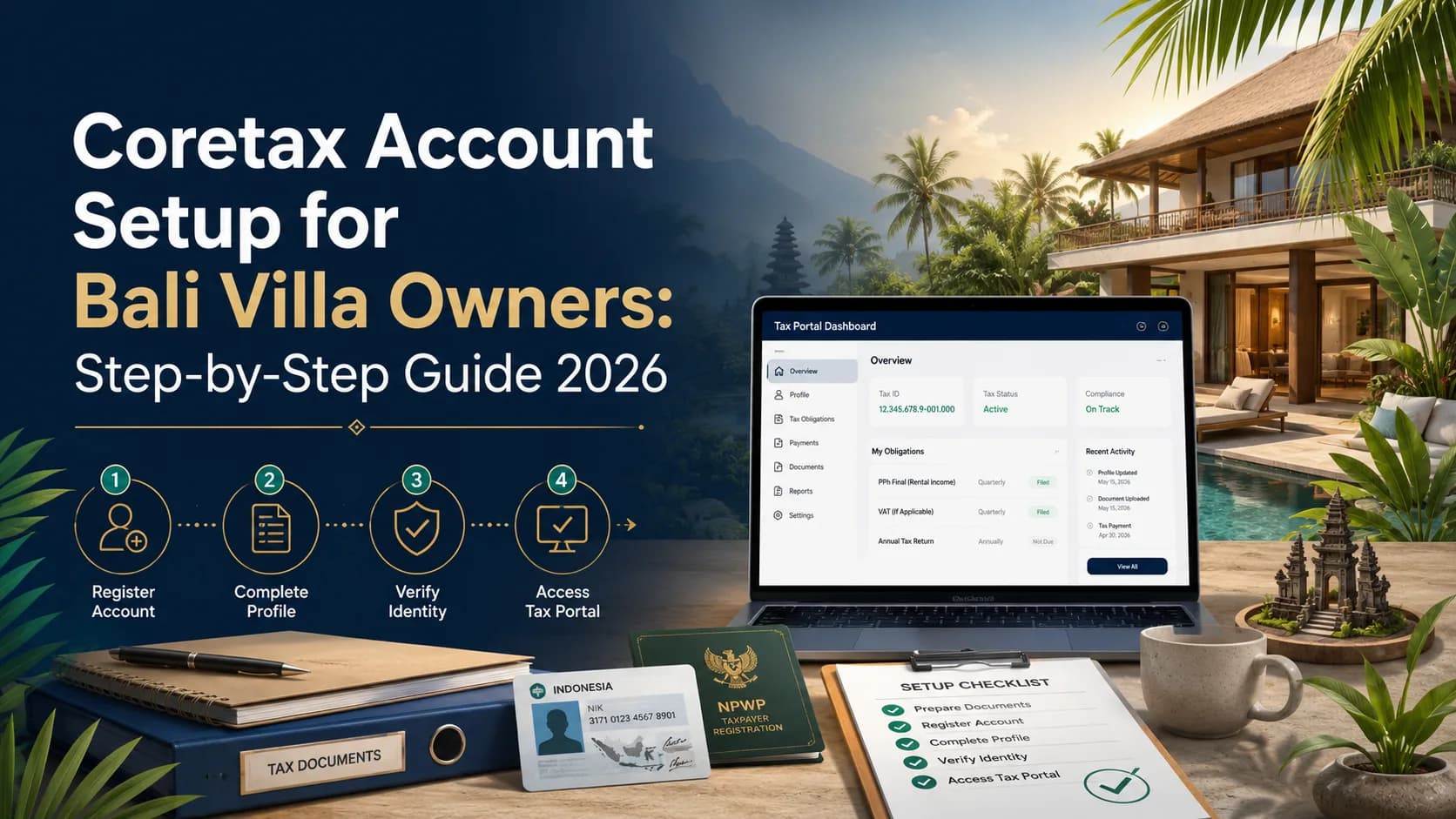
Coretax account setup for Bali villa owners is no longer an optional back-office task — it is becoming the entry point for almost every tax interaction with Indonesia's Direktorat Jenderal Pajak (DJP). If you own, manage, or invest in a villa in Bali and earn rental income through Airbnb, Booking.com, Agoda, Traveloka, or direct bookings, your Coretax profile is where NPWP data, tax categories, and filings now converge. This guide explains, step by step, how to prepare your documents, verify your taxpayer identity, and organize your villa's financial records before you sit down at the Coretax portal. We also look at how a platform like Villa Tax helps owners and accountants collect, structure, and archive the information Coretax setup requires. Tax rules can evolve, and the exact screens or workflow inside Coretax may change over time — always confirm specifics with DJP or a licensed local tax advisor before filing. What follows is a practical roadmap, not legal advice, built for foreign investors, property managers, and Indonesian resident owners alike who want to walk into Coretax setup prepared rather than improvising.
What Is Coretax and Why Does It Matter for Bali Villa Owners?
Coretax is Indonesia's unified digital tax administration system, built by DJP to centralize taxpayer registration, filing, and payment in one platform. For Bali villa owners, it matters because rental income, PBJT-related regional levies, and withholding obligations increasingly flow through the same digital identity tied to your NPWP.
Before Coretax, taxpayers often dealt with separate logins, paper submissions, and fragmented e-Faktur or e-Filing tools. Coretax consolidates these under a single account architecture linked to the taxpayer's NPWP, replacing older systems in stages. For a villa generating recurring OTA and direct-booking revenue, this means your Coretax profile becomes the reference point auditors, accountants, and DJP officers will check first.
Key Takeaway: Coretax is not a villa-specific tool — it is Indonesia's general tax administration platform, and villa owners are simply one category of taxpayer who must use it correctly.
Because villa income streams are often split across multiple OTAs, property managers, and sometimes multiple entities (individual, CV, or PT PMA), the setup phase is where most future reporting friction is created or avoided. Getting the taxpayer profile, documentation, and access rights right at the start saves considerable time during monthly and annual reporting cycles.
Who Needs a Coretax Account for a Bali Villa?
Anyone who earns, manages, or is fiscally responsible for villa rental income in Indonesia may need a Coretax account, though the specific role differs by structure. This section separates the tax owner from the operational manager, since confusing the two is one of the most common setup mistakes.
Individual Indonesian resident owner — taxed personally, NPWP-linked profile.
Foreign individual owner — may need a fiscal representative depending on structure and residency status.
PT PMA (foreign-owned company) — corporate NPWP, separate obligations from personal accounts.
Pondok Wisata registered operators — small-scale tourism accommodation with specific local registration.
Villa management company — may hold operational access without being the taxpayer of record.
Property manager overseeing multiple villas — often needs multi-entity visibility, not ownership.
External accountant — needs delegated access, not primary control.
Authorized fiscal representative — required in many non-resident scenarios.
Villas operating through Airbnb or Booking.com — income still flows to a specific taxpayer identity regardless of platform.
Villas with direct-booking revenue — must be reconciled into the same taxpayer profile as OTA income.
Compliance Tip: Distinguish clearly between the tax owner (whose NPWP is on file), the operational manager (who runs the villa day to day), the accountant (who prepares filings), the authorized representative (who may interact with DJP on the owner's behalf), and the economic beneficiary (who ultimately receives the income). Coretax access should mirror this structure, not blur it.
Documents You Need Before Setting Up Coretax
Gathering the right documents before you open a Coretax session prevents delays and reduces the risk of mismatched data. Requirements vary by ownership structure, so treat the table below as a checklist to confirm against your own situation with DJP or an advisor.
Document | Who Needs It | Why It Matters | Common Mistake |
|---|---|---|---|
NPWP | All taxpayers | Core identity for Coretax profile | Using an outdated or personal NPWP for a company |
NIK or equivalent ID | Individuals | Identity verification | Mismatched name spelling vs official ID |
Company registration data | PT PMA | Corporate tax profile setup | Missing updated SK Kemenkumham data |
Pondok Wisata documents | Small tourism operators | Local business legality | Assuming Pondok Wisata replaces tax registration |
Fiscal representative details | Foreign owners | Required in many non-resident cases | Leaving representative fields blank |
Active email and phone | All taxpayers | OTP and notification access | Using an inbox no one checks |
Banking details | All taxpayers | Payment and refund reconciliation | Mixing personal and villa accounts |
Proof of ownership or management | Owners and managers | Confirms legal link to the property | No formal management contract on file |
Operational documents | Managers | Supports revenue classification | Missing lease or operating agreements |
Rental revenue data | All | Basis for tax calculations | Not separating OTA vs direct income |
OTA history exports | Villa operators | Reconciliation with declared income | Incomplete Airbnb/Booking.com history |
Management contracts | Owners using agencies | Clarifies who reports what | Verbal-only agreements |
Invoices | All | Expense and revenue substantiation | Missing invoices for cleaning, staff, maintenance |
Payment confirmations | All | Audit trail | No bank statement backup |
Staff documents | Employers | Payroll-linked obligations | Undocumented informal staff |
BPJS documents | Employers with staff | Social security compliance | Ignoring BPJS entirely |
Step-by-Step Coretax Account Setup for Villa Owners
The steps below outline a general preparation sequence. Exact screens, buttons, and workflows inside the official DJP Coretax portal may vary or change over time — always verify the current process directly on the portal or with a licensed local tax advisor before proceeding.
Step 1: Confirm Your Taxpayer Status
Determine whether the villa income is reported under an individual NPWP, a CV, or a PT PMA. This decision drives every later step, since Coretax profiles are structured around a single taxpayer identity per registration.
Common mistake: Assuming personal and business income can be merged under one profile without consequences. Practical tip: Confirm the correct taxpayer category with your accountant before touching the portal.
Step 2: Verify Your NPWP Information
Check that your NPWP details — name, address, tax office (KPP), and status — are current. Outdated NPWP data is one of the most frequent causes of failed verification during Coretax setup.
Common mistake: Using an NPWP registered to a previous address or an inactive status. Practical tip: Request an NPWP status confirmation from your tax office or advisor beforehand.
Step 3: Prepare Your Business or Property Documents
Assemble ownership deeds, leasehold agreements, PT PMA incorporation documents, or Pondok Wisata registration depending on your structure, as outlined in the document table above.
Common mistake: Relying on documents that have expired or were never formally renewed. Practical tip: Villa Tax helps centralize these documents in one place so they are ready when needed.
Step 4: Confirm Your Email and Phone Access
Coretax relies on OTP-based verification. Make sure the email and phone number on file are actively monitored, not an old address from a previous manager or accountant.
Common mistake: Leaving a former employee's contact details linked to the account. Practical tip: Update contact details before starting any registration or verification step.
Step 5: Access the Official DJP Coretax Portal
Only use the official DJP domain (pajak.go.id) to access Coretax. Avoid third-party links claiming to offer shortcuts or "faster" registration.
Common mistake: Following unofficial links found on forums or social media. Practical tip: Bookmark the official portal directly from the DJP website.
Step 6: Complete Identity Verification
This step typically involves confirming personal or corporate identity data against DJP records. The exact verification flow may vary depending on taxpayer category and should be followed as presented on the official portal.
Common mistake: Rushing through verification with mismatched name formats. Practical tip: Have your ID, NPWP, and company documents open side by side during this step.
Step 7: Link the Correct Tax Profile
Ensure the profile you are linking corresponds to the correct taxpayer — personal, CV, or PT PMA — and not a legacy or duplicate registration from an earlier system.
Common mistake: Villa owners sometimes discover a second, forgotten NPWP created years earlier. Practical tip: Ask your advisor to check for duplicate registrations before linking.
Step 8: Assign Access for Accountants or Representatives
Where applicable, grant delegated access to your accountant or authorized fiscal representative rather than sharing your own login credentials directly.
Common mistake: Sharing personal credentials with a bookkeeper who then becomes a single point of failure. Practical tip: Use role-based access whenever the portal supports it, and document who has access.
Step 9: Review Your Tax Obligations
Once your profile is active, review which obligations apply to your villa — PBJT (a regional levy, not filed through Coretax itself), PPh Final or PPh Badan depending on structure, and PPN if turnover thresholds are exceeded.
Common mistake: Assuming all villas share identical obligations regardless of structure or revenue level. Practical tip: Have your accountant map your specific obligations against your Coretax profile.
Step 10: Organize Your Villa Revenue Records
Separate OTA revenue (Airbnb, Booking.com, Agoda, Traveloka) from direct bookings and cash payments. Consistent categorization here prevents reconciliation problems later.
Common mistake: Mixing net payouts from OTAs with gross booking values. Practical tip: Villa Tax's OTA connectivity layer helps structure this data by source before it reaches your accountant.
Step 11: Prepare for Monthly Reporting
Set a recurring internal calendar for revenue collection, invoice checks, and filing preparation, since Coretax obligations for many taxpayers follow monthly cycles.
Common mistake: Treating tax preparation as a once-a-year task. Practical tip: Build a simple monthly checklist, even a basic spreadsheet, before investing in more advanced tooling.
Step 12: Create a Compliance Archive
Keep filings, payment confirmations, contracts, and OTA reports in a single, dated archive — physical or digital — that can be produced quickly if DJP requests supporting evidence.
Common mistake: Scattering documents across email inboxes and personal drives. Practical tip: A centralized dashboard reduces the time needed to respond to any future audit request.
Coretax Setup Checklist for Bali Villa Owners
Taxpayer identity validated (individual, CV, or PT PMA)
NPWP active and data current
Email actively monitored
Phone number actively monitored
Property ownership or lease documents ready
Company documents ready (if applicable)
Accountant or representative access defined
Tax categories confirmed (PBJT, PPh, PPN where applicable)
Revenue history organized by source
OTA data exported and structured
Monthly fiscal calendar in place
Document archive centralized
Backups of key filings maintained
Audit trail established for revenue and payments
How Coretax Connects to Villa Tax Reporting
Coretax centralizes the taxpayer identity, but the underlying revenue data — PBJT collections, PPh withholdings, OTA reconciliation — still has to be organized before it reaches the portal. This is where a Bali villa tax compliance workflow becomes the practical layer sitting beneath your Coretax profile.
Villa income typically involves PBJT collected from the guest, PPh obligations calculated on net or gross income depending on structure, and in some cases withholding at source through OTA platforms or property managers. A structured Coretax reporting workflow means monthly revenue is already categorized, invoices are matched to bookings, and a digital audit trail exists before any filing deadline arrives. For owners managing several properties, a multi-villa compliance dashboard makes it possible to see obligations property by property rather than reconstructing everything from scratch each month.
Manual Coretax Preparation vs Villa Tax Workflow
Feature | Manual Spreadsheet | Accountant Only | Generic Accounting Software | Villa Tax |
|---|---|---|---|---|
Multi-villa tracking | Limited | Depends on accountant | Partial | Yes |
OTA revenue organization | Manual | Manual | Partial | Structured |
Coretax document preparation | Manual | Yes, but time-consuming | Partial | Centralized |
Audit trail | Weak | Depends on records kept | Partial | Built-in |
Owner dashboard | No | No | Sometimes | Yes |
Document centralization | No | Depends | Partial | Yes |
Monthly compliance visibility | Low | Depends | Partial | Yes |
Staff and BPJS document tracking | No | Depends | Rarely | Supported |
Foreign owner clarity | Low | Depends on advisor | Low | Structured guidance |
Villa Tax does not replace an accountant or DJP — it organizes, centralizes, and prepares the information your accountant and Coretax filing ultimately depend on.
Common Coretax Setup Mistakes Villa Owners Make
Using an incorrect or outdated NPWP
Mixing personal and villa business income
Not separating OTA revenue from direct payments
Failing to keep management contracts on file
Using an email address no one checks
Leaving a former accountant with account access
Not documenting cash payments
Failing to archive invoices systematically
Ignoring PBJT obligations
Ignoring PPh obligations tied to the correct structure
Confusing the property owner with the operator
Not documenting staff-related costs
Forgetting Booking.com or Agoda income in reconciliation
Underestimating the likelihood of a DJP review
Not maintaining a digital audit trail
Waiting until the filing deadline to organize records
Not verifying obligations specific to the local district
Failing to update contact information after a change of manager
Coretax for Foreign Villa Owners and PT PMA Structures
Foreign villa owners face additional considerations because Coretax access and tax obligations depend heavily on ownership structure — direct foreign ownership is restricted, so most foreign investors operate through PT PMA, leasehold arrangements, or, in riskier cases, informal nominee structures.
A PT PMA has its own corporate NPWP and Coretax profile, separate from any individual owner or director. Leasehold structures usually keep the underlying landowner as a distinct taxpayer from the leaseholder generating rental income. Nominee arrangements, where an Indonesian individual holds legal title on behalf of a foreign owner, carry documented legal and fiscal risk and are generally discouraged by legal advisors. Where dividends flow from a PT PMA to a foreign shareholder, PPh 26 withholding typically applies, and Double Tax Avoidance (DTA/P3B) treaty benefits may reduce certain withholding rates depending on the treaty and the nature of the income — though real estate rental income is often treated differently under Article 6 of the OECD Model Convention and may not benefit from the same treaty relief as other income types.
Structure | Coretax Access Considerations | Tax Risk | Recommended Documentation |
|---|---|---|---|
Direct foreign ownership | Not generally available for land | High legal risk | Avoid; consult a legal advisor |
PT PMA | Separate corporate profile | Moderate, structured | Incorporation documents, NPWP Badan |
Leasehold | Owner and leaseholder distinct profiles | Moderate | Lease agreement, registered term |
Nominee arrangement | Legally exposed, discouraged | High | Independent legal review strongly advised |
Property manager only | Operational access, not tax owner | Low if roles are clear | Management contract |
How to Prepare OTA Revenue for Coretax Reporting
OTA revenue reporting risk grows quickly when data from Airbnb, Booking.com, Agoda, Traveloka, Expedia, and Vrbo is not reconciled against direct bookings, bank deposits, and cash payments before filing.
Booking Source | Data to Collect | Tax Reporting Risk | Best Practice |
|---|---|---|---|
Airbnb | Payout reports, host earnings summary | Net vs gross confusion | Reconcile gross booking value, not payout |
Booking.com | Invoice and commission reports | Commission deducted before payout | Track commission separately |
Agoda | Payment reports | Currency conversion mismatches | Record local currency equivalent |
Traveloka | Booking and payout history | Local platform-specific fees | Archive monthly statements |
Expedia | Partner central reports | Delayed payout cycles | Match payout date to booking date |
Vrbo | Owner dashboard exports | Similar issues to Airbnb | Apply same gross-value reconciliation |
Direct bank transfer | Bank statements | Easy to under-report | Cross-check against booking calendar |
Cash payments | Manual receipts | Highest under-reporting risk | Issue and retain receipts systematically |
Security deposits | Refund records | Confused with taxable income | Exclude refunded deposits from revenue |
Cleaning fees | Invoice records | Sometimes omitted from revenue | Include as part of gross rental revenue where applicable |
For platform-specific policies, consult the Airbnb Help Center and the Booking.com Partner Hub, which document current payout and reporting mechanics for hosts and partners.
Monthly Coretax Workflow for Villa Managers
Day of Month | Task | Owner | Document Needed | Risk if Missed |
|---|---|---|---|---|
1-3 | Collect prior month revenue | Manager | OTA and bank exports | Incomplete monthly picture |
4-6 | Reconcile OTA vs direct income | Manager/Accountant | Platform reports | Under- or over-reporting |
7-9 | Verify invoices and expenses | Accountant | Invoices, receipts | Missed deductions |
10-12 | Review staff and BPJS obligations | HR/Accountant | Payroll records | Payroll compliance gaps |
13-15 | Review tax categories (PBJT, PPh) | Accountant | Revenue summary | Miscategorized income |
16-18 | Prepare Coretax filing data | Accountant | Consolidated records | Filing delays |
19-21 | Validate figures with owner | Owner/Accountant | Draft report | Owner unaware of exposure |
22-24 | Submit payment where due | Accountant | Payment confirmation | Late payment penalties |
25-27 | Archive completed filing | Manager | Filing copy | Lost audit trail |
28-30 | Update owner dashboard | Manager | Monthly summary | Reduced owner visibility |
Coretax Audit Preparation for Bali Villas
An audit or review can request bank statements, OTA reports, invoices, contracts, and filing history, so consistency between what was declared and what supporting documents show is the single most important preparation factor.
Preparing evidence in advance means keeping rental agreements and management contracts current, ensuring bank statements match declared revenue, retaining OTA reports for the relevant periods, and preserving copies of every monthly filing alongside payment confirmations. A digital audit trail — dated, consistent, and centralized — significantly reduces the time needed to respond to a DJP request.
OTA reports
Bank statements
Invoices
Rental agreements
Management contracts
Tax filings
Payment confirmations
Guest records where relevant
Payroll files
BPJS documents where applicable
Owner reports
Accountant notes
Coretax Setup Flowchart
flowchart TD
    A[Confirm Taxpayer Status] --> B[Verify NPWP Data]
    B --> C[Prepare Villa Documents]
    C --> D[Access DJP Coretax Portal]
    D --> E[Complete Identity Verification]
    E --> F[Link Tax Profile]
    F --> G[Assign Accountant Access]
    G --> H[Organize Revenue Records]
    H --> I[Prepare Monthly Reporting]
    I --> J[Maintain Compliance Archive]

    style A fill:#c9a962,color:#0c0e14
    style J fill:#10b981,color:#fff


How Villa Tax Simplifies Coretax Preparation
Villa Tax is built around the practical reality described throughout this guide: villa owners juggle multiple OTAs, changing regulations, and scattered documents, and Coretax setup goes more smoothly when that information is already organized. The platform centralizes property documents, tracks fiscal obligations villa by villa, and structures OTA revenue from Airbnb, Booking.com, Agoda, and direct bookings into a consistent format before it reaches an accountant.
For property managers overseeing several villas, a multi-villa compliance dashboard replaces scattered spreadsheets with a single view of obligations, deadlines, and document status. The platform's digital audit trail keeps invoices, payment confirmations, and filings archived together, which matters both for monthly reporting and for any future review. Foreign owner tax documentation — including PT PMA records and representative details — can also be structured within the same workspace, alongside collaboration tools that let accountants review data without needing full account credentials.
Villa Tax connects naturally into the broader OPERIUM ecosystem: identity and onboarding checks can run through KYC-Flow, management agreements can be formalized via Contract-Sign, agencies managing several owners can use Partner-Portal for branded reporting, service completions can be documented with Proof-of-Service, and owners looking for a broader tax document management layer beyond villas can explore Tax-Shield. The full range of tools is available in the OPERIUM product catalog.
None of this replaces DJP, a licensed accountant, or a qualified tax advisor. What it does is reduce the chance that Coretax setup and monthly reporting are undermined by missing documents, inconsistent revenue records, or an incomplete audit trail.
FAQ — Frequently Asked Questions
Is Coretax mandatory for Bali villa owners?
Yes, Coretax is Indonesia's official tax administration system and applies to registered taxpayers generally, including villa owners earning rental income. The exact scope of mandatory use can evolve, so confirm your specific filing requirements with DJP or a licensed local tax advisor.
Do I need an NPWP to use Coretax?
Yes, an active NPWP is the core identifier required to create and use a Coretax profile. Villa owners without a current NPWP, or with an outdated one, should resolve this before attempting account setup, as it is one of the most frequent causes of failed verification.
Can a foreign villa owner create a Coretax account?
In many cases, yes, though the process and access typically depend on the ownership structure — individual, PT PMA, or leasehold — and may require a fiscal representative. Foreign owners should confirm the applicable pathway with DJP or a local tax advisor before proceeding.
Can my accountant access my Coretax account?
Yes, delegated access for accountants or authorized representatives is generally supported, and using role-based access is safer than sharing personal login credentials. Always document who has access and review this periodically, especially after a change of accountant.
What documents are needed before setting up Coretax?
Villa owners typically need an active NPWP, valid identification, property or company documents, active contact details, and organized revenue records. The full document checklist in this guide outlines requirements by ownership structure in more detail.
How does Coretax affect Airbnb income in Bali?
Airbnb income still flows to the same taxpayer identity registered in Coretax, regardless of the platform used. Villa owners should reconcile gross booking values, not just net payouts, to avoid under-reporting Airbnb-sourced revenue.
Does Booking.com income need to be reported through Coretax?
Yes, Booking.com revenue is part of the same taxable rental income as any other booking source and should be reconciled into your Coretax-linked tax profile. Commission deductions should be tracked separately from gross booking value for accurate reporting.
What happens if my Coretax data is incorrect?
Incorrect data can lead to filing errors, mismatched records during a review, or delays in processing. Villa owners who discover outdated NPWP details, duplicate registrations, or incorrect profile links should correct this with DJP or an advisor as soon as possible.
Can Villa Tax file taxes directly in Coretax?
Villa Tax helps organize, centralize, and prepare the documentation and revenue records that filings depend on, but it does not replace DJP, a licensed accountant, or the act of filing itself. Owners should work with a qualified professional for the actual submission.
How should I prepare for a Coretax audit?
Preparation means keeping OTA reports, bank statements, invoices, contracts, and prior filings consistently archived and reconciled against declared income. A digital audit trail maintained monthly, rather than assembled reactively, significantly reduces audit response time.
Is Coretax different from local PBJT reporting?
Yes, PBJT is a regional tax levy collected on gross rental revenue and is typically administered separately from Coretax, which handles national tax obligations like PPh and PPN. Villa owners should verify both regional and national requirements, as they are not interchangeable.
How often should villa owners review Coretax records?
Monthly review is generally recommended given the recurring nature of rental income and associated obligations. Waiting until an annual deadline increases the risk of missing documents, unreconciled OTA data, or overlooked filing periods.
Conclusion
Coretax account setup for Bali villa owners rewards preparation: a verified NPWP, organized property and company documents, clearly separated OTA and direct revenue, and defined access for accountants or representatives all reduce friction before, during, and after filing. Villa Tax helps villa owners organize the documents, revenue records, and compliance workflows needed before tax filing, while keeping accountants and owners aligned in one place across single or multiple properties. As rules can change and obligations depend on your specific ownership structure, always verify your situation with DJP, a licensed accountant, or a qualified local tax advisor before making filing decisions. To see how a structured, centralized approach to Bali villa tax compliance and Coretax reporting can work for your property or portfolio, visit Villa Tax.
For official guidance, consult the Direktorat Jenderal Pajak (DJP) and the Ministry of Finance of Indonesia directly, and for broader investment and tourism regulatory context, see BKPM and the Ministry of Tourism and Creative Economy.
frequently asked