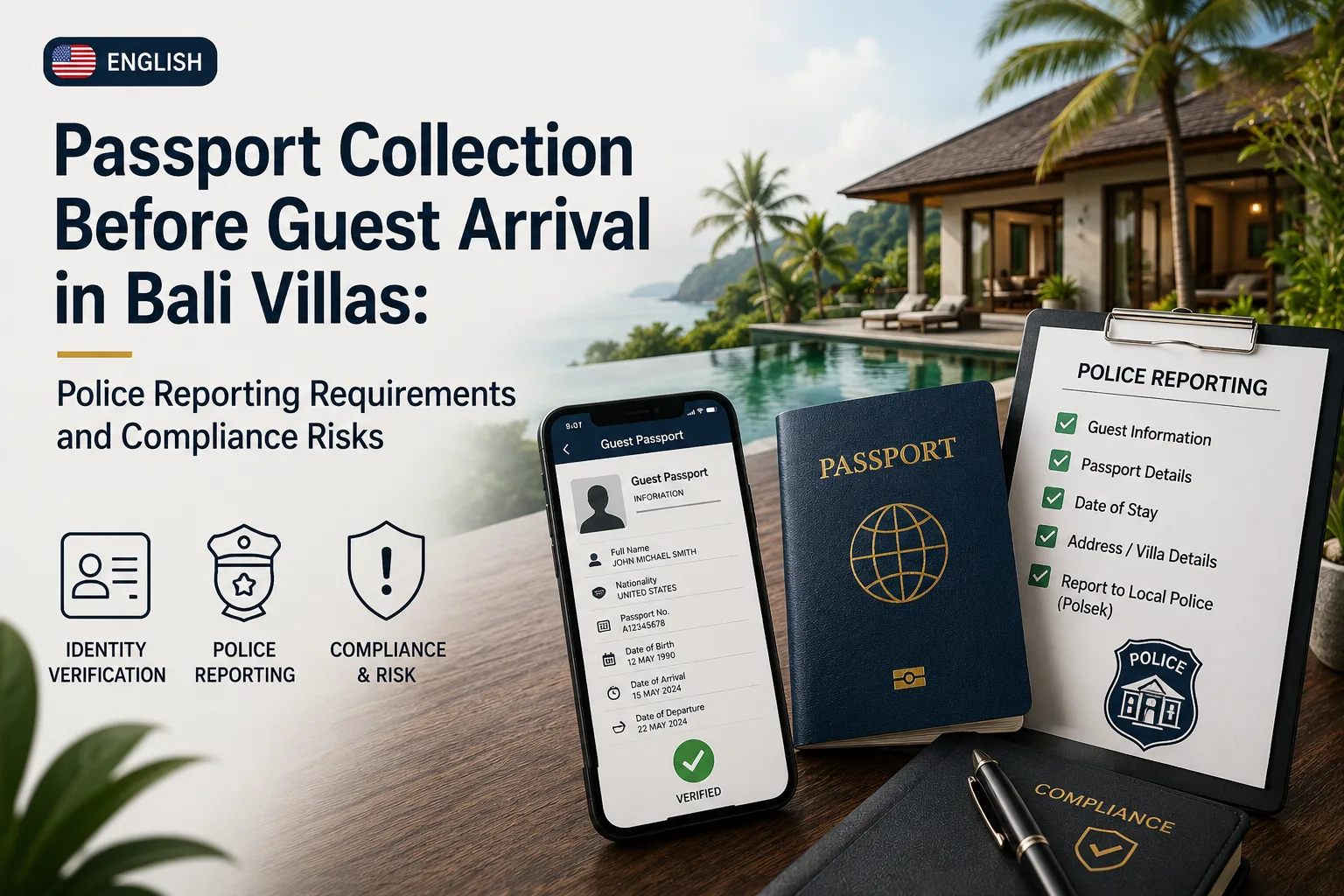
If you manage or own a villa in Bali, you already know the moment well: a confirmed booking lands in your inbox, and before you can relax, your front-of-house team needs the guest's passport collection before guest arrival in order to start the paperwork. This is not an arbitrary preference dreamed up by an overzealous villa manager. It sits at the intersection of Indonesian immigration law, local police reporting obligations for foreign guests, and an increasingly digitized tourism compliance environment that is tightening every year. This comprehensive guide explains, step by step, how to bring structure to the otherwise manual and error-prone process of collecting, verifying, and reporting passport data for foreign tourists staying in private villas across Bali — and why getting this wrong is one of the most frequently asked questions among new villa owners and management agencies alike.
Indonesia's tourism sector has matured rapidly since the post-pandemic rebound, and with that maturity has come a parallel tightening of administrative oversight. Villa owners who once treated guest registration as a courtesy now find themselves squarely inside a regulatory perimeter that includes immigration reporting, local police notification duties, and, increasingly, fiscal traceability requirements tied to platforms like VillaTax. This article walks through every layer of that obligation, the practical risks of getting it wrong, and how digital workflows — rather than WhatsApp threads and email attachments — are becoming the only defensible way to manage guest documentation at scale.
Why Villas Request Passport Copies Before Check-In
The single most frequently asked question new villa owners pose to their property managers is some version of: "why do villas collect passport information before the guest has even arrived?" The honest answer is that passport collection serves three distinct and overlapping purposes.
Identity Verification and Fraud Prevention
The first and most obvious purpose is identity verification. Villas, unlike hotels with 24/7 front desks and CCTV-monitored lobbies, often operate with minimal on-site staff — sometimes just a daily housekeeper and a remote-managed booking calendar. This makes villas a slightly higher-risk environment for booking fraud, stolen credit card usage, or guests attempting to misrepresent the size of their party. Collecting passport information before arrival allows the villa management team to cross-check the name on the booking platform against the name on the payment method and the name on the identity document, closing a fraud loophole that has cost villa owners across Bali significant sums over the years.
This identity cross-check matters more in Bali's villa market than in many other tourism destinations precisely because of the property type involved. A hotel room represents a contained, easily monitored unit; a villa, by contrast, often comes with multiple bedrooms, a private pool, staff quarters, and sometimes adjoining land — making it an attractive target for parties who book under one identity but arrive with a substantially larger or different group than declared. A villa manager who has collected and verified passport data for the lead guest has a documented basis to address occupancy disputes if they arise mid-stay rather than discovering the discrepancy only after damage has occurred.
There is also a quieter but equally important fraud dimension specific to high-value short-term rentals: chargeback fraud. A guest who books a villa for a week, stays the full duration, and then disputes the charge with their card issuer can cause significant financial harm to an owner or agency that lacks documentation proving the guest's identity matched the person who actually checked in. Passport verification, cross-referenced against the payment method used for booking, provides exactly this kind of documentary backstop.
Police Reporting and Immigration Compliance
The second purpose, and the one most owners underestimate, is the legal obligation many Indonesian regencies impose on accommodation providers — including private villas, not just licensed hotels — to report the presence of foreign nationals to the local police (Polsek or Polres) within a defined window after arrival. This obligation traces back to longstanding Indonesian administrative practice around foreigner movement tracking, reinforced by national-level digitization efforts under the Direktorat Jenderal Imigrasi. While enforcement intensity varies by regency — Badung, Gianyar, and Denpasar tend to be the most active in practice — the underlying legal expectation is consistent: accommodation providers are expected to know, and be able to demonstrate, who is staying on their premises and for how long.
It is worth pausing on why this expectation exists at all. Indonesia, like many countries that rely heavily on tourism revenue while simultaneously managing significant internal security priorities, treats foreigner movement tracking as a baseline public safety function rather than a tourism-specific inconvenience. The same underlying infrastructure that tracks foreign guests in hotels for security purposes is, in principle, meant to extend to villas and any other form of paid accommodation.
Fiscal and Tax Traceability
The third purpose, increasingly relevant since the rollout of Coretax and the broader digitalization of Indonesian tax administration, is fiscal traceability. Villa revenue is subject to PBJT (the local tourism tax) and, depending on the owner's residency status, PPh Final or PPh Badan. Guest registration records, including passport-derived nationality and length-of-stay data, increasingly form part of the audit trail that connects booking platform payouts to declared revenue. Platforms like VillaTax are built specifically to bridge this gap, converting raw guest and booking data into the fiscal documentation Indonesian authorities expect to see during a Coretax cross-check.
When DJP auditors examine a villa owner's declared revenue, one of the most basic cross-checks available to them is comparing the number of nights a property was occupied against the revenue declared for that period. A villa that shows substantial occupancy but comparatively modest declared revenue presents an immediate red flag. Conversely, a villa with clean, complete guest records that align closely with declared revenue presents a far less attractive target for deeper investigation.
The Practical Reality on the Ground
In practice, most Bali villas request passport scans through one of three channels: a pre-arrival email, a WhatsApp message, or — increasingly — a digital check-in form embedded in the booking confirmation. Each of these channels carries different levels of risk, both from a data protection standpoint and from a documentation-integrity standpoint.
A point worth emphasizing here is that the channel through which passport information is collected matters almost as much as the fact that it is collected at all. A passport photo buried in a WhatsApp thread alongside dozens of unrelated messages is, from a compliance documentation perspective, barely better than not having collected it at all — it cannot easily be retrieved, verified, cross-referenced, or presented coherently to a police officer or auditor.
Understanding Indonesian Guest Registration Requirements
To understand why passport collection before guest arrival has become standard practice, it helps to step back and look at the legal architecture underpinning foreigner registration in Indonesia. This is not a single law but a layered system combining national immigration regulation, regional police practice, and specific hospitality registration duties.
The National Immigration Framework
At the national level, foreigners entering Indonesia are subject to immigration control administered by the Direktorat Jenderal Imigrasi, part of the Ministry of Law and Human Rights. Visa-on-arrival, e-Visa, and visa-free arrangements all funnel through the same underlying principle: the Indonesian state wants to know who is in the country, where they are staying, and for how long. This is reflected in the long-standing requirement for accommodation providers to maintain a register of foreign guests.
This national framework has evolved considerably over the past decade, moving from a purely paper-based system toward an increasingly digital one. Bali, as the country's single largest foreign tourism destination by volume, sits at the leading edge of this digitization effort.
Siskoharlat and Digital Reporting Systems
Indonesia has experimented with several digital systems intended to centralize foreigner accommodation reporting, often referred to informally under names like Siskoharlat in various regional pilot programs. These systems let hotels and registered accommodation providers submit guest data directly to a centralized police or immigration database, rather than relying on paper registers.
For villas operating outside the formal hotel licensing framework, the picture is murkier. Many villas are not formally registered as hotels and therefore fall into a gray zone where the expectation of guest reporting exists in practice — enforced informally by local Banjar customary structures and periodic police sweeps — without always being backed by a single, unambiguous national digital reporting mandate specific to villas.
Regional Variation Across Bali's Nine Regencies
Bali is administratively divided into eight regencies (kabupaten) and one city (Denpasar), each with its own Perda governing tourism and accommodation. Badung — home to Seminyak, Canggu, Uluwatu, and Kuta — has historically been the most aggressive regency in enforcing both tax registration and guest reporting expectations. Gianyar (Ubud) and Denpasar follow closely. Buleleng, Tabanan, Klungkung, Bangli, Karangasem, and Jembrana have historically seen lighter enforcement, though this is shifting as Coretax-linked fiscal scrutiny increases.
In Badung, villa managers routinely describe periodic Polsek sweeps as a normal part of operating a tourism business. Gianyar, anchored by Ubud's wellness tourism market, sees guests staying longer, which changes the reporting cadence. The remaining regencies have historically experienced lighter enforcement intensity, but this gap is closing as tourism expands into less-saturated markets.
Why This Matters for Villa Owners Specifically
The critical point for villa owners to internalize is this: the absence of a single, perfectly clear national law specifically addressing villa guest reporting does not mean the absence of legal risk. A villa owner who has never been asked to produce a guest register may simply not yet have been inspected — not necessarily because no obligation exists. This ambiguity is exactly why structured, documented passport collection before guest arrival functions as a defensive practice even where the specific letter of the law is unclear.
Police Reporting Obligations for Tourist Accommodation
Understanding the theoretical legal framework is one thing; understanding what police reporting obligations actually look like in day-to-day practice across Bali's tourism corridors is another.
Who Is Expected to Report, and to Whom
In the traditional hospitality model, the front desk at a licensed hotel collects passport copies and either enters guest data into a digital system connected to local police or maintains a physical register. For villas, the "front desk" function is typically distributed across the property manager, a designated staff member, or the booking platform host acting through a local representative.
The Surat Keterangan Lapor Diri Practice
Some regencies have historically used a document referred to informally as a Surat Tanda Lapor Diri — essentially a confirmation that a foreign national's presence has been reported and acknowledged by local authorities. Villa managers in high-tourism-density areas like Canggu and Seminyak frequently maintain informal relationships with local Polsek offices precisely so that a documented history of guest reporting demonstrates good-faith compliance.
Timing Windows and Practical Deadlines
The practical working assumption among compliance-conscious villa managers is to treat 24 hours after check-in as the de facto reporting window. This mirrors broader international tourism reporting norms and provides a defensible standard even where local Perda is less explicit.
The Role of Village (Banjar) Administration
A distinctly Balinese dimension is the role of the Banjar — the traditional customary village unit that retains real administrative authority over local affairs, including informal oversight of guest presence in villas. Banjar leaders (Kelian Banjar) in tourism-heavy areas often coordinate directly with Polsek offices on reporting matters.
What a Police Inquiry Actually Looks Like
A police inquiry into guest presence is rarely dramatic. It typically takes one of three forms: a routine Polsek visit during a broader sweep, a targeted inquiry following a specific incident, or an inquiry triggered by immigration authorities cross-checking visa records against accommodation data.
What Happens if a Villa Fails to Report Foreign Guests
This is consistently among the most frequently asked questions from villa owners new to the Bali market, and the honest answer requires nuance: consequences range from negligible to genuinely serious.
Administrative and Reputational Consequences
The most common consequence is administrative friction: a villa manager unable to quickly answer a Polsek inquiry faces delays, repeat visits, and a generally adversarial relationship with local authorities.
Liability Exposure for the Villa Owner
A critical point often missed: liability for guest reporting failures typically attaches to the property owner or registered business entity, not solely to the on-the-ground manager. This is precisely the gap that the Bouclier Conformité service from PT Asiah Legal Jaya is designed to address.
Compounding Risk With Immigration Violations
The scenario that genuinely escalates risk is when inadequate guest reporting intersects with an actual immigration violation — most commonly a visa overstay. The villa becomes implicated in the investigation by default, even without knowledge of the overstay.
Tax and Fiscal Cross-Reference Risk
A growing dimension of risk connects guest reporting failures to fiscal exposure. As DJP continues cross-referencing OTA-reported revenue against tax declarations, gaps in guest registration data can surface as inconsistencies during an audit. This is one of the core reasons platforms like VillaTax integrate guest and booking data directly into the fiscal calculation engine.
Criminal Exposure in Extreme Cases
In rare but real cases, Indonesian authorities have pursued more serious investigations under broader immigration and criminal statutes against villas knowingly hosting guests without identity verification.
The Compounding Effect of Multiple Properties
For management agencies overseeing a portfolio of properties, a pattern of inconsistencies across multiple villas signals systemic non-compliance and invites a fundamentally more severe regulatory response.
Data Privacy and Passport Storage Risks
Collecting passport data before guest arrival solves one set of compliance problems while creating another: passports are sensitive identity documents, and mishandling them exposes villa owners to risk under both Indonesian data protection law and, for European guests, the GDPR.
Why Passport Photos Are High-Risk Data
A passport biodata page contains a guest's full legal name, date of birth, nationality, passport number, and photograph — effectively a complete identity fingerprint. Villa owners who casually forward scans via WhatsApp or store them unencrypted are creating exactly the kind of exposure data protection regulators increasingly scrutinize.
GDPR Exposure for European Guests
Indonesia is not an EU member, but the GDPR follows the data subject, not the processor's location. A French, German, or Dutch guest booking a Bali villa is, under prevailing GDPR interpretation, a data subject whose passport information falls within the scope of GDPR obligations.
Indonesia's Own Data Protection Law — UU PDP
Indonesia enacted UU PDP No. 27/2022, entering full enforcement in October 2024, imposing obligations strikingly similar to the GDPR: lawful basis for processing, data minimization, defined retention periods, breach notification duties, and significant penalties.
The 24-Hour Retention Principle
A consistent best practice is to treat passport photographs as transient compliance artifacts rather than permanent records. Once relevant data points have been extracted, the underlying image should be deleted, typically within 24 hours of guest checkout.
Common Data Handling Mistakes
Common mistakes include storing scans in shared drives accessible to all staff, forwarding scans via unencrypted WhatsApp, printing physical copies improperly disposed of, and retaining images for years with no defined deletion policy.
Building a Defensible Data Handling Policy
A defensible policy should specify who is authorized to view raw images, how long they are retained, where structured data is stored, and what happens in the event of a breach.
Manual Processes vs Digital Compliance Workflows
The Manual Baseline: Email and WhatsApp
The default workflow for most independently operated Bali villas remains startlingly manual. A staff member manually transcribes relevant fields into a spreadsheet, paper register, or nowhere at all beyond the original message thread.
Why Manual Processes Fail at Scale
This approach is tolerable for an owner managing a single villa. It breaks down rapidly for agencies overseeing dozens of properties, where the volume of incoming images becomes operationally unmanageable.
The Audit Trail Problem
A WhatsApp thread provides weak evidentiary value — messages can be deleted, timestamps are ambiguous, and there is no structured record connecting passport data to the specific booking and reporting action.
What a Digital Compliance Workflow Looks Like
A modern workflow triggers an automated pre-arrival message with a secure upload link, extracts and validates key fields, logs structured data with a timestamp, and feeds that data directly into both the police reporting workflow and the fiscal calculation engine. VillaTax exemplifies this approach.
The Time Cost Comparison
Agencies transitioning to digital workflows report reductions from 15-20 minutes of manual work per guest down to under 2 minutes of staff oversight.
Step-by-Step Compliance Process for Villa Managers
Step 1: Request Passport Information at Booking Confirmation, Not Check-In
Moving the request earlier gives guests time to respond and gives staff a buffer to follow up on non-responsive guests.
Step 2: Use a Structured Intake Form, Not Free-Form Chat
Structured intake dramatically reduces transcription errors compared to free-form exchanges.
Step 3: Verify the Document Before Arrival, Not After
Verifying document quality before arrival avoids awkward on-site confrontations.
Step 4: Extract Structured Data and Discard the Raw Image on a Defined Schedule
An automatic deletion schedule — commonly 24 hours after checkout — minimizes exposure while preserving the structured record needed for compliance.
Step 5: Submit or Log the Police Reporting Action Within the Local Window
The action itself should be logged with a timestamp, constituting defensible evidence of good-faith compliance.
Step 6: Feed Structured Guest Data Into the Fiscal Calculation Layer
Guest data should flow directly into PBJT, PPh, and PPN calculation rather than existing as a disconnected record — the core principle behind VillaTax.
Step 7: Maintain a Five-Year Structured Archive, Separate From Raw Documents
Indonesian fiscal retention requirements expect five years of retained records, supporting both audits and retrospective inquiries.
Common Mistakes Made by Villa Owners
Mistake 1: Treating Passport Collection as Optional for "Trusted" Repeat Guests
This creates an inconsistent record that is difficult to defend during an audit.
Mistake 2: Relying Entirely on the OTA's Own Guest Verification
OTA verification is not equivalent to Indonesian police reporting or fiscal documentation requirements.
Mistake 3: Storing Passport Images Permanently "Just in Case"
Over-retention accumulates liability under data protection law without corresponding compliance benefit.
Mistake 4: No Designated Owner for the Compliance Process
Without a clearly designated owner, accountability diffuses and gaps emerge.
Mistake 5: No Reconciliation Between Guest Records and Tax Declarations
This is precisely the gap that surfaces during a Coretax cross-check.
Mistake 6: Assuming Compliance Requirements Are Static
Villa owners who built habits years ago risk operating on outdated assumptions.
How Villa Tax Simplifies Administrative Compliance
VillaTax was built specifically to address the structural gap described throughout this guide.
Centralizing Guest and Booking Data
VillaTax ingests booking data from over 310 supported OTA integrations into a single structured system, anchoring the compliance trail to the same record that captures revenue.
Automated Fiscal Calculation Tied to Real Booking Data
Every booking triggers the appropriate calculation — PBJT, PPh Final, PPh Badan for PT PMA structures, and PPN where applicable.
Coretax-Ready Reporting
VillaTax's reporting layer is purpose-built to produce documentation aligned with what Coretax audits expect.
A Compliance Shield for Owners Who Cannot Be On-Site
The Bouclier Conformité service provides structured oversight, alerting, and direct support during DJP inquiries.
Multi-Property Visibility for Agencies
VillaTax provides dashboard-level visibility to manage compliance consistently across an entire portfolio.
Comparison: Passport and Guest Compliance Workflows in Bali
Process | Manual Collection | Spreadsheet Register | Hotel-Grade PMS | VillaTax |
|---|---|---|---|---|
Secure document handling | No | Partial | Yes, typically | Yes, scheduled deletion |
Audit trail with timestamps | Weak | Moderate | Strong | Strong, automated |
Police reporting preparation | Manual, ad hoc | Manual | Often built-in | Structured and ready |
Data centralization | None | Limited | Yes, within chains | Yes, full portfolio |
Fiscal data reconciliation | None | Manual | Not typically integrated | Native integration |
Multi-property management | Very difficult | Difficult | For hotel chains | Purpose-built for villas |
GDPR / UU PDP alignment | Poor | Depends on operator | Often compliant | Built-in principles |
Guest Registration to Compliance Archive Workflow
flowchart TD
    A[Guest Booking Confirmed] --> B[Pre-Arrival Passport Request]
    B --> C[Structured Document Upload]
    C --> D[Document Verification]
    D --> E[Data Extraction]
    E --> F[Police Reporting Logged]
    E --> G[Fiscal Engine Calculation]
    F --> H[Compliance Archive 5 Years]
    G --> H
    D --> I[Raw Image Deleted in 24 Hours]

    style A fill:#c9a962,color:#0c0e14
    style H fill:#10b981,color:#fff
    style I fill:#ef4444,color:#fff
FAQ — Frequently Asked Questions
Is it legal to request a passport before arrival in Bali?
Yes, requesting a passport copy before arrival is legal and widely practiced across Bali's villa and hotel sector. It supports identity verification, fraud prevention, and the reporting obligations accommodation providers are generally expected to fulfill for foreign guests.
Why do villas collect passport information?
Villas collect passport information to verify guest identity, support police and immigration reporting obligations, and maintain the fiscal documentation trail needed to reconcile booking revenue with tax declarations.
Are villa owners required to report foreign guests?
In most tourism-dense Bali regencies, accommodation providers face a practical expectation to identify foreign guests and report their presence within roughly 24 hours of arrival.
Can passport copies be sent by WhatsApp?
Technically yes, but this is not a best practice. WhatsApp threads provide weak audit trail value and create indefinite, poorly controlled data retention.
How long should passport data be retained?
The raw image should be deleted within 24 hours of checkout, while structured data is retained for the longer period required for fiscal recordkeeping, typically five years.
What are the risks of poor document management?
Poor document management increases breach exposure, weakens evidentiary value during inquiries, and creates inconsistencies that can trigger costly discrepancies during a tax audit.
Can Villa Tax help manage guest compliance?
Yes. VillaTax centralizes booking and guest data, ties it into automated fiscal calculation, and structures records to support audit readiness.
What happens during a compliance audit?
Authorities expect organized, dated records connecting guest identity, length of stay, and declared revenue. Centralized records resolve audits faster with lower penalty risk.
Conclusion
Passport collection before guest arrival in Bali villas sits at the intersection of identity verification, police and immigration reporting expectations, and fiscal traceability tied to PBJT and PPh declarations under growing Coretax scrutiny. VillaTax was purpose-built to close this gap. Explore VillaTax and the broader OPERIUM product ecosystem to see how centralizing this workflow can reduce both administrative burden and regulatory risk.