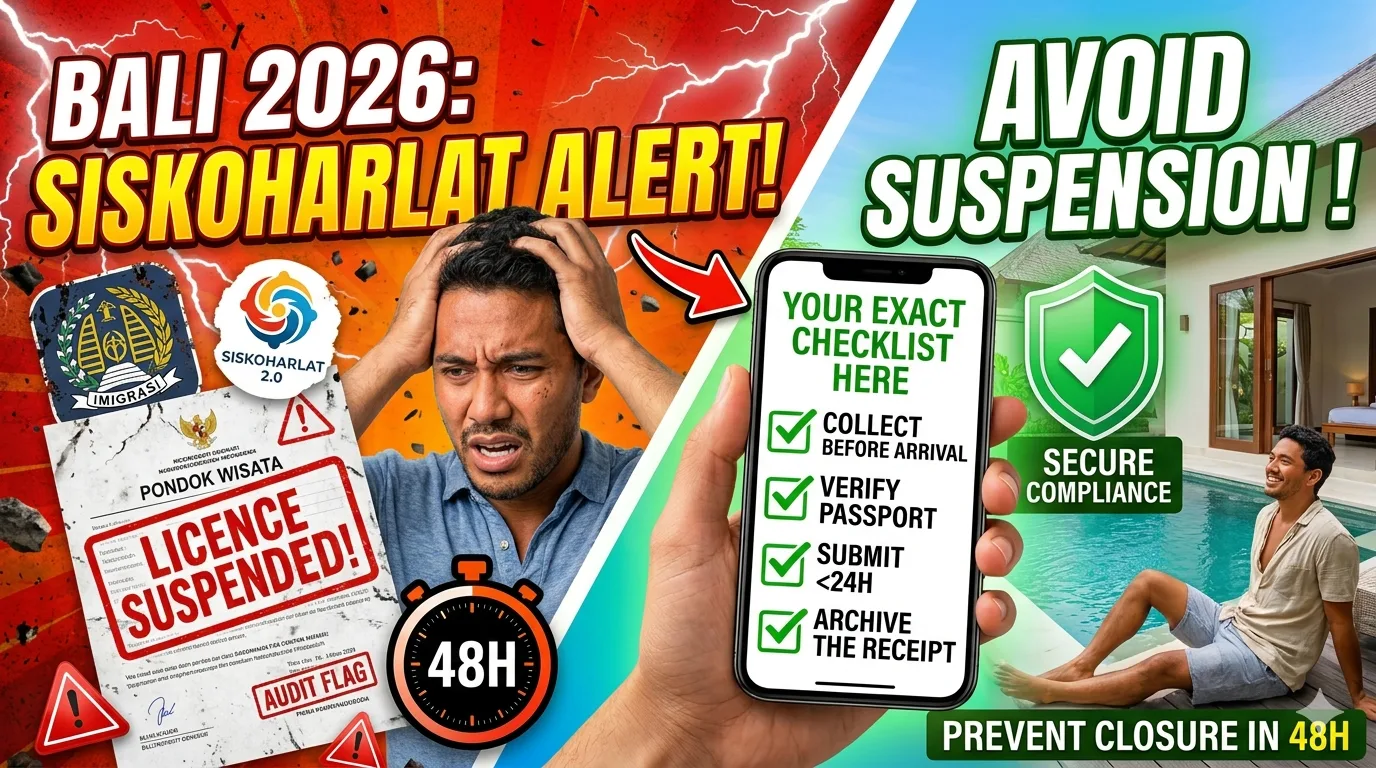
The Indonesian Immigration Directorate does not operate on the same timeline as the tax authority. While Coretax may take months to initiate an audit, Siskoharlat enforcement moves in 48 hours. A single missed foreign guest report can trigger a license suspension that closes your villa before your next Airbnb check-in arrives. This guide covers exactly what Siskoharlat requires, why untrained staff is the most common compliance failure point, and how to implement a watertight guest reporting process that works whether you're on-site or managing remotely. The siskoharlat frequently asked questions from villa owners all point to the same root problem: they understand the law exists, but they don't have a system that executes it consistently. This guide provides that system.
What Siskoharlat Is and Why It Moves Faster Than Tax Enforcement
Siskoharlat — Sistem Informasi Pelaporan Orang Asing (Foreign Person Reporting Information System) — is the digital infrastructure through which Indonesia tracks the movement and accommodation of foreign nationals. For villa owners and pondok wisata operators in Bali, it creates a specific legal obligation: every foreign guest must be officially reported to the local police or banjar within 24 hours of their check-in.
This is not a new regulation. The underlying legal obligation has existed since Law No. 6/2011 on Immigration and Government Regulation No. 31/2013. What changed in 2026 is enforcement intensity. The Siskoharlat 2.0 system upgrade integrated real-time data cross-referencing between immigration authorities, Bali's banjar network, Airbnb guest nationality data, and local police systems. The result: a reporting gap that previously might go unnoticed for months now generates an automatic flag within 24-48 hours.
The enforcement distinction from tax compliance is critical for villa operators to understand. PBJT non-compliance creates financial liability that accumulates over time. Siskoharlat non-compliance triggers an administrative sanction that can suspend your operating license immediately — shutting down bookings, triggering Airbnb listing suspension, and potentially affecting your visa status as a foreign property owner.
The timeline from missed report to license suspension is not theoretical. In 2025, before the Siskoharlat 2.0 upgrade, several dozen pondok wisata operators in Badung and Gianyar received suspension notices within 48-72 hours of immigration cross-referencing identifying unreported foreign guests. The 2026 system is faster and more automated.
Who Is Required to Report Under Siskoharlat
The reporting obligation falls on the accommodation operator — meaning the person or entity holding the Pondok Wisata license, not the guest. This is a crucial legal distinction. Your guest has no obligation to register themselves. You, as the license holder, are legally responsible for ensuring every foreign national who stays at your property is reported within the 24-hour window.
For foreign-owned villas operating under PT PMA structures, the reporting obligation typically falls on the Indonesian director or management company designated in the PT PMA documents. For properties operating under nominee arrangements, the legal responsibility sits with the nominee — but the practical consequence (license suspension, property closure) falls on the foreign investor who depends on that license to generate rental income.
The Pondok Wisata License and Why Suspension Is Catastrophic
A Pondok Wisata license (Tanda Daftar Usaha Pariwisata — TDUP for accommodation) is the primary operating permit for small-scale villa rentals in Bali. Without it, operating as a short-term rental is illegal. The license is issued by the relevant regency's DPMPTSP (investment and integrated licensing service) and can be suspended by the local immigration office, police authority, or by the Satuan Polisi Pamong Praja (Satpol PP) — Bali's local regulatory enforcement arm.
A suspended Pondok Wisata license means: no legal short-term accommodation business, immediate requirement to cease operations, and — critically — automatic flagging with the OTAs. Airbnb, Booking.com, and Agoda all require valid operating licenses for listed properties. A suspension event, once it enters official records, can trigger an OTA listing deactivation that outlasts the actual suspension period, as each platform has its own reinstatement process.
For a villa generating $5,000-$15,000/month in bookings, even a 2-week suspension during peak season represents $2,500-$7,500 in lost income — far exceeding the cost of any compliance infrastructure.
The 24-Hour Requirement: What It Means Operationally
Indonesian immigration law requires that every foreign national staying at a registered accommodation be reported to the local police authority within 24 hours of check-in. Under Siskoharlat 2.0, this reporting is digitized — it no longer requires a physical visit to the police station for each guest. But the 24-hour window is absolute, and the digital submission must contain specific data fields to be valid.
What Data Must Be Collected and Reported
A valid Siskoharlat submission requires the following for each foreign guest:
| Data Field | Source | Format Required |
|---|---|---|
| Full name (as on passport) | Passport bio page | Exact match |
| Passport number | Passport bio page | Alphanumeric |
| Nationality | Passport bio page | ISO country code |
| Date of birth | Passport bio page | DD/MM/YYYY |
| Visa type | Visa stamp or VOA receipt | Category code |
| Date of arrival in Indonesia | Entry stamp | DD/MM/YYYY |
| Address of accommodation | Your property registration | Registered address |
| Check-in date | Booking record | DD/MM/YYYY |
| Check-out date | Booking record | DD/MM/YYYY |
This data must be accurate. Transcription errors — a transposed digit in a passport number, a misspelled name — can invalidate the submission and count as non-reporting. Manual data entry from a photographed passport creates transcription risk at every step.
The 24-Hour Clock: When It Starts
The 24-hour window begins at the moment of physical check-in — not at the booking confirmation, not at the scheduled check-in time, but when the guest physically arrives at the property. For late-night or early-morning arrivals (common in Bali given flight schedules from Australia, Japan, and Europe), this means the reporting obligation may arise at 2am and expire at 2am the following night.
Staff who are not explicitly trained on the 24-hour trigger point routinely assume the clock starts at the official check-in time listed on the booking, or at the start of the next business day. Both assumptions are wrong and create compliance gaps.
The Real Risk: Why Untrained Staff Is Your Biggest Vulnerability
Most Bali villa suspensions under Siskoharlat trace back not to deliberate non-compliance but to a single operational failure: a staff member who either forgot to collect passport data, collected it incorrectly, stored it insecurely, or submitted the report after the 24-hour window expired.
Training your staff or risking your Pondok Wisata license is not a metaphor — it is the literal operational reality. Your license exists in your name. Your staff's failure is your legal failure.
The Four Staff Failure Modes
Failure Mode 1: No collection. The most common and most damaging. The guest arrives, the staff member (often a villa manager or housekeeper acting as informal check-in host) greets them, shows them the villa, and simply fails to ask for the passport. This happens especially with guests who arrive tired from long flights and are visibly eager to settle in without bureaucratic friction. The staff member, wanting to provide good hospitality, defers the passport request — and sometimes forgets it entirely.
Failure Mode 2: Incomplete collection. The staff member photographs the passport cover but not the bio page. Or photographs the bio page but not the visa stamp. The Siskoharlat submission fields cannot be completed with partial data, and the resulting submission is invalid.
Failure Mode 3: Insecure storage. This is a privacy law risk in addition to an immigration compliance risk. Storing passport scans in a WhatsApp chat history, an unencrypted smartphone camera roll, or an unlocked filing cabinet creates data protection liability. Indonesia's Personal Data Protection Law (UU PDP, Law No. 27/2022), which entered enforcement in 2024, imposes obligations on accommodation operators who collect and process personal data — which passport scans unambiguously are.
Failure Mode 4: Late submission. The data was collected correctly, but the submission to the digital reporting system was delayed — either because the staff member didn't know the deadline, couldn't access the system, or submitted on day 2 instead of day 1. A submission at hour 25 is technically non-compliant.
Why Remote Management Compounds the Risk
For foreign villa owners who manage their Bali property remotely — which is the majority of the market — staff compliance failures are invisible until they become license suspension notices. There is no real-time visibility into whether the villa manager asked for the passport at check-in, whether the data was correctly transcribed, or whether the submission was made before the 24-hour window closed.
The standard approach to this problem — a WhatsApp message to the manager asking "did you report the guests?" — is both operationally unreliable and legally meaningless. It produces an assurance but not evidence. If immigration asks for a record of compliance, a WhatsApp message saying "yes I did it" is not a valid response.
The Complete Siskoharlat Compliance Checklist
This checklist is designed for implementation by any villa with local staff, regardless of whether the owner is on-site. It covers three phases: pre-arrival, check-in day, and the 24-hour submission window.
flowchart TD
    A[Booking Confirmed] --> B[Pre-Arrival: Guest Contact]
    B --> C[Send Passport Request via WhatsApp]
    C --> D{Passport Received?}
    D -->|Yes - Before Arrival| E[Pre-validate Data Fields]
    D -->|No - Follow Up 24h Before| F[Second Request + Reminder]
    F --> G[Check-in Day: Verify on Arrival]
    E --> G
    G --> H[Confirm Passport vs Booking Data]
    H --> I[Submit Siskoharlat Report - within 24h]
    I --> J{Submission Confirmed?}
    J -->|Yes| K[Archive Submission Proof]
    J -->|No - Error| L[Correct and Resubmit Immediately]
    K --> M[Compliance Record Stored]
    style A fill:#c9a962,color:#0c0e14
    style I fill:#10b981,color:#fff
    style M fill:#10b981,color:#fff
    style L fill:#ef4444,color:#fff
Phase 1: Pre-Arrival — Collect Before They Land
The most reliable way to eliminate the 24-hour time pressure is to collect passport data before the guest arrives in Bali. This requires a systematic pre-arrival communication process that requests the necessary data as part of the booking confirmation sequence.
Collecting passport data securely before guest arrival eliminates the primary failure mode (no collection at check-in) and gives you time to validate the data for completeness before the 24-hour clock starts.
Pre-Arrival Checklist:
- Send a pre-arrival message to the guest 48-72 hours before check-in
- Request: full name as on passport, passport number, nationality, date of birth, visa type, Indonesia arrival date
- Provide a secure upload link (not a WhatsApp chat request for photos)
- Confirm receipt and validate that all required fields are present
- Pre-populate the Siskoharlat submission form with received data
The channel for this communication matters. A WhatsApp message asking the guest to photograph their passport and send it back via WhatsApp creates the insecure storage problem (Failure Mode 3). The image lands in the staff member's personal WhatsApp history, which is neither secure, nor properly archived, nor GDPR-compliant for EU guests.
Phase 2: Check-In Day — Verify and Lock
On the day of arrival, the pre-collected data must be physically verified against the actual passport. This step cannot be eliminated even when pre-collection was successful, because the data on file must match the document the guest carries.
Check-In Day Checklist:
- Ask to see the physical passport (not a photo of it)
- Verify that the name, passport number, and date of birth match the pre-collected data exactly
- Check the visa stamp: is it the correct visa type declared? Has it expired?
- Confirm the Indonesia arrival date matches the entry stamp
- Note the check-in date and expected check-out date
- Do not return the passport until the verification is complete
The verification step should take less than two minutes. It should not be skipped under any circumstances, including for guests who express impatience or fatigue.
Phase 3: Submission — Before the 24-Hour Window Closes
This is the phase where most compliance failures actually occur. The data has been collected, the guest has checked in, but the submission to the Siskoharlat system doesn't happen before the 24-hour window closes.
Submission Checklist (must be completed within 24 hours of check-in):
- Access the Siskoharlat digital reporting system
- Input all required data fields for the guest
- Submit and receive confirmation receipt
- Screenshot or download the confirmation receipt
- Store the confirmation receipt in a designated property compliance folder (not a personal device)
- Log the submission date and time
The confirmation receipt is critical. If immigration later queries a guest's stay at your property, the receipt is your proof of compliance. A submission without a receipt provides no protection. A staff member who says "I submitted it but forgot to save the receipt" is in the same position as one who never submitted at all.
Comparison: Manual Siskoharlat Compliance vs. VillaTax Pro
| Compliance Method | Collection Process | Submission Speed | Data Security | Audit Trail | Cost/Month |
|---|---|---|---|---|---|
| Manual (staff WhatsApp) | Inconsistent, depends on staff | Often late | Not secure | None | $0 + risk |
| Paper logbook | Systematic but slow | Requires office visit | Not secure | Partial | $0 + risk |
| Google Forms | Partially systematic | Still manual submit | Basic | Partial | $0 + risk |
| VillaTax Pro (WhatsApp Bot) | Automated pre-arrival | Real-time | Encrypted + compliant | Full | $59/mo |
What Happens When You Get It Wrong: Suspension Scenarios
Understanding the specific failure-to-suspension pathway helps illustrate why this compliance cannot be treated as optional.
Scenario A — Single missed report. A guest checks in on a Thursday evening. The villa manager forgets to collect passport data. Friday passes. Saturday, immigration's automated system flags the property address against Airbnb guest nationality data and finds a foreign national with no corresponding Siskoharlat report. A compliance notice is issued Monday. The operator has 48 hours to respond with documentation or face suspension.
Scenario B — Repeated late submissions. The villa has been submitting Siskoharlat reports, but typically on day 2 or day 3 after check-in. Immigration's system records the submission timestamps. A pattern of consistently late submissions constitutes systematic non-compliance, which carries a heavier sanction than a single incident — typically immediate suspension rather than a warning notice.
Scenario C — Data error invalidating a submission. A staff member transposed two digits in a passport number. The submission passed the system's front-end validation (some fields aren't verified in real time) but failed a backend reconciliation check against immigration records. The submission is retroactively flagged as invalid. The operator is notified that their compliance record contains an invalid submission, which counts as a non-reporting event.
How VillaTax Pro's WhatsApp Guest Bot Eliminates These Risks
The WhatsApp Guest Bot in VillaTax Pro was designed specifically to solve the four staff failure modes described above. It replaces the staff-dependent data collection process with an automated, guest-facing workflow that operates independently of whether your villa manager remembers, is trained, or is even at the property.
How the Bot Works
Trigger: When a booking is confirmed in VillaTax (via OTA import or manual entry), the system automatically schedules a pre-arrival message to the guest.
Delivery: 48 hours before check-in, the guest receives a WhatsApp message in their own language. An English-speaking Australian guest receives the message in English. A French guest gets it in French. A Japanese guest gets it in Japanese.
Content: The message explains that your property requires passport registration per Indonesian immigration law (framing it as legal compliance, not an intrusive request), provides a secure upload link, and gives the guest clear instructions on what to photograph and upload.
Secure collection: The guest uploads their passport via a secure, encrypted portal linked from the WhatsApp message. The data is stored in VillaTax's compliance database — not in a staff member's personal WhatsApp.
Automatic pre-population: VillaTax uses the uploaded data to pre-populate the Siskoharlat submission form, ready for the final verification step at check-in.
Submission and archiving: After check-in verification is confirmed in VillaTax, the system submits the Siskoharlat report and archives the confirmation receipt against the booking record.
Audit trail: Every step is timestamped and stored: when the message was sent, when the guest uploaded their data, when check-in verification was confirmed, when the submission was made, and the submission receipt number.
The entire process is visible to the property owner in real time, regardless of geographic location. Remote management becomes fully auditable.
FAQ — Frequently Asked Questions
What exactly is Siskoharlat and who does it apply to?
Siskoharlat (Sistem Informasi Pelaporan Orang Asing) is Indonesia's digital system for reporting foreign nationals staying at registered accommodations. It applies to all holders of Pondok Wisata or other accommodation operating licenses (TDUP) who host foreign guests. The reporting obligation is on the operator, not the guest. Every foreign national must be reported within 24 hours of check-in, regardless of how short the stay is.
Does the 24-hour rule apply to all foreign guests, including those on tourist visas?
Yes. The 24-hour reporting requirement applies to all foreign nationals regardless of visa type — tourist visa, visa on arrival, business visa, retirement visa, or digital nomad visa. There are no exemptions based on visa category, length of stay, or nationality. Even a guest checking in for a single night must be reported within 24 hours.
What happens if my guest arrives late at night and I can't access the reporting system?
The 24-hour clock starts at the moment of physical check-in, not at business hours. If your guest arrives at 11pm, you have until 11pm the following night to submit the report. The Siskoharlat digital system is accessible 24/7. If you're using VillaTax Pro, the pre-arrival WhatsApp Bot has already collected the passport data before the guest arrives, so the submission can be processed immediately regardless of arrival time.
Can I delegate the Siskoharlat reporting to my villa manager?
Yes — the physical act of reporting can be delegated to a designated staff member. However, the legal responsibility for compliance remains with the license holder. If your manager fails to report, you face the suspension consequences. This is why systematic, documented training and an automated backup process (such as VillaTax Pro's WhatsApp Bot) are essential rather than optional for remote villa owners.
What are the penalties for non-compliance with Siskoharlat?
Penalties range from a warning notice (first offense, rapid correction possible) to operating license suspension (repeated violations or systematic non-compliance) to criminal liability for the license holder in cases of willful non-reporting. Under Immigration Law No. 6/2011, Article 115, accommodation operators who willfully fail to report foreign guests face fines up to IDR 25,000,000 and potential imprisonment. License suspension is the most common outcome and can occur within 48 hours of a non-compliance flag.
Does Siskoharlat reporting require visiting the police station?
No. Siskoharlat 2.0 is a fully digital system. Reporting is done online through the system's web portal or via authorized third-party applications. Physical police station visits are no longer required for routine guest reporting. VillaTax Pro's WhatsApp Bot handles the digital submission automatically within the compliance workflow.
How is Siskoharlat different from the old APOA reporting system?
The old APOA (Aplikasi Pelaporan Orang Asing) system required a physical visit to the local police for each foreign guest registration. Siskoharlat digitized this process and integrated it with immigration databases, making enforcement automated and cross-referenced against OTA booking data. The 24-hour rule was the same, but enforcement was manual and infrequent. With Siskoharlat 2.0, enforcement is automated and near-real-time.
My villa operates in a remote area of Bali. Does Siskoharlat still apply?
Yes. Siskoharlat applies across all of Bali's regencies, regardless of location. There is no geographic exemption for properties in less-visited areas. If anything, properties in areas with lower compliance rates may face disproportionate enforcement as the system identifies non-reporting clusters by regency.
What data protection obligations apply to passport data I collect from guests?
Under Indonesia's Personal Data Protection Law (UU PDP, Law No. 27/2022), passport data constitutes sensitive personal data. You are required to: collect only the minimum data necessary, store it securely with appropriate technical safeguards, retain it only for as long as legally required, and not share it with unauthorized parties. Collecting passport scans via WhatsApp and storing them in an unencrypted chat history violates these requirements. VillaTax Pro's encrypted passport collection portal is specifically designed to meet UU PDP compliance requirements.
Can Siskoharlat non-compliance affect my visa status as a foreign villa owner?
Yes, in cases of repeated or serious non-compliance. While a single missed report typically results in a property-level sanction (license warning or suspension), a pattern of non-compliance can trigger an investigation into the underlying property ownership and operating structure. For foreign nationals whose visa status is partly based on their property investment activities, this creates indirect visa risk.
How much does VillaTax Pro cost and what does it include?
VillaTax Pro is priced at $59/month and includes all Starter plan features (PBJT/PPh calculations, multi-platform booking import, regency-appropriate filing) plus the WhatsApp Guest Bot for automated passport collection and Siskoharlat compliance, multi-property management for up to 10 properties, and full audit trail documentation suitable for immigration authority review.
Conclusion: The Tax Authority Has Months. Immigration Has 48 Hours.
The Coretax tax compliance risk described in our previous guide operates on a timeline of months — the DJP builds its case gradually as booking data accumulates and cross-referencing flags patterns. You have a window for voluntary correction that can meaningfully reduce your exposure.
Siskoharlat has no such window. A missed guest report creates an enforcement flag within 24-48 hours that can produce a license suspension notice before your guest has even checked out. The operational disruption, OTA listing deactivation, and reputational damage from a suspension event cannot be undone retroactively.
The solution is not discipline or diligence — it is systematization. A process that depends on a staff member remembering to ask for a passport at 2am after a tired guest arrives from a 14-hour flight will fail. A process that asks the guest for their passport via WhatsApp in their own language 48 hours before they land, stores it securely, pre-fills the compliance form, and submits automatically within the 24-hour window does not fail.
VillaTax Pro's WhatsApp Guest Bot is that system. At $59/month, it costs less than a single night's booking revenue at most Bali villas — and it protects the revenue of every night that follows.
→ Upgrade to VillaTax Pro — Activate the WhatsApp Guest Bot Today